Find your level
Two minutes of honest questions online, then a five-minute in-water placement check in your first class. If the tool guessed wrong, we move your swimmer that same week.
Not sure where to start? Two minutes of honest questions finds your level. Find your level
A swim school, not a pool with classes
One 32°C teaching pool in Port Moody, a fourteen-rung level ladder you can read before you ever visit, instructors who move swimmers up the week they're ready — and every price on one page.
How Sunfish works
Two minutes of honest questions online, then a five-minute in-water placement check in your first class. If the tool guessed wrong, we move your swimmer that same week.
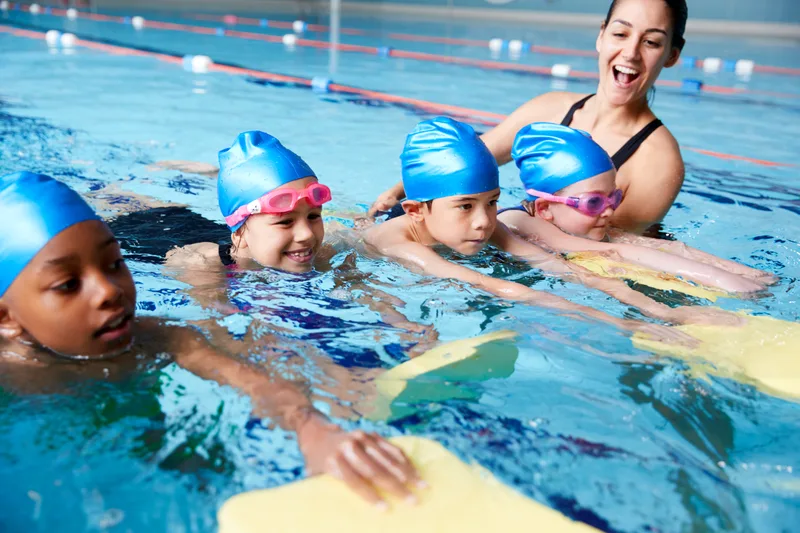
Weekly 30-minute lessons in groups of four (or less). Consistency is the whole trick — swimming is muscle memory, and muscle memory hates gaps.
Instructors assess against published skill checklists continuously. Level moves happen mid-month, not at the end of a billing 'session'. You never pay to repeat owned skills.
The level ladder
4 months – 3 years
You in the water together. Comfort, cues, and safe habits — long before technique.
1 level →
3 – 5 years
Four short rungs from face-in-the-water to first real strokes, at most four kids per instructor.
4 levels →
6 – 12 years
Six levels from first bubbles to 100 continuous metres and all four strokes.
6 levels →
13+
Learn-to-swim without judgment, or a stroke clinic to fix what self-teaching built.
2 levels →
8 – 14 years
The bridge from lessons to lap swimming or swim club — endurance, starts, and turns.
1 level →
Prefer one-on-one? Private lessons run 30 minutes at $62 — and we'll tell you honestly when group is the better buy.

Safety before strokes
Roll-to-rest, jump-turn-return, clothed swims, deep-water self-rescue — threaded through every rung from Tadpoles to Swim Strong. A certified lifeguard watches every lesson from the deck, our ratios are published and audited, and we will never call a child "drown-proof," because no honest school would.
Read the safety standardsThe schedule
The weekly grid shows real spots — including the classes that are honestly full, so you can plan around the Saturday rush instead of discovering it at the front desk.
See the weekly gridThe pricing
Flat monthly tuition for weekly lessons, the $48/year family registration fee explained before you pay it, and a makeup policy written in plain sentences.
Read the pricing pageFrom the viewing gallery
“I'm 41 and I couldn't put my face in water. Sam never once made it weird. Four months later I swam 25 metres while my kids watched. I'd have paid double, and I'm glad I didn't have to.”
“The level page told me exactly what P2 meant before we ever visited, and the placement check matched it. Nobody has ever tried to upsell me — they actually moved my daughter up mid-month without being asked.”
“Teaching is genuinely excellent — June is a magician. Four stars because Saturday spots are a bloodbath: we sat on the P3 waitlist for six weeks. Go weekday afternoons if you possibly can.”
Straight answers
Honestly: it varies, and anyone who quotes you one number is selling something. Industry-wide, kids typically need somewhere between 20 and 50 hours of instruction to become genuinely water-safe — for weekly 30-minute group lessons, that usually means 12 to 24 months from first bubble to a confident, unassisted swim (our S3-level skills). Frequency is the biggest lever: two classes a week roughly halves the calendar time, which is why the second weekly class is 15% off. What we promise is not a date — it's that you'll always know exactly which level your child is in, what skill is next, and that we'll move them the week they're ready.
Use the find-your-level tool — it asks a swimmer's age and a few honest comfort questions and recommends a starting level with the reasoning shown. Then, in the first five minutes of your first class, the instructor runs a short in-water placement check to confirm. If the tool guessed wrong, we move your swimmer that same week and adjust nothing on your bill.
The week they're ready — not at the end of a 'session.' Instructors assess continuously against the published skill checklists, and level moves happen mid-month whenever a swimmer clears their rung. You'll never pay to repeat skills a child already owns.
Find your level
Tell us the swimmer's age and what they can already do — the level tool recommends a starting rung, shows you why, and lists the real open classes for it.