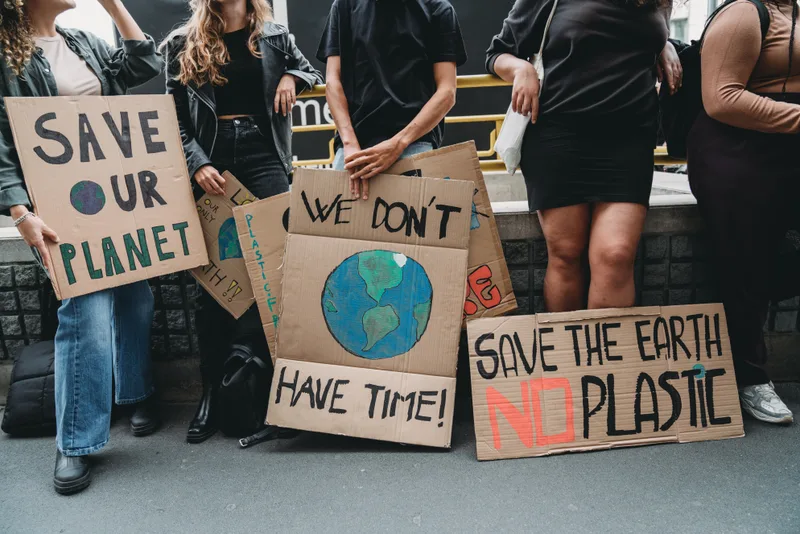
The climate issue
What we're fighting for + against
Climate change is the defining issue of our time. The science is settled. The political response is not. Forward Climate Coalition advocates for policy + action commensurate with the scale + urgency of climate crisis.
The climate science
What the evidence shows
Global warming + emissions
Earth’s climate is warming due to human-caused greenhouse gas emissions. Scientific consensus 97%+. CO2 atmospheric concentration: 280 ppm pre-industrial → 425 ppm today. Highest in 800,000 years (likely 3 million).
Already-observed impacts
Sea level rise (~9 inches since 1880, accelerating). Ocean acidification + warming. Polar ice loss. Extreme weather increasing (hurricanes, floods, droughts, wildfires). Already affecting human communities + ecosystems.
Future projection scenarios
Best case (rapid emissions reductions): ~1.5-2°C warming above pre-industrial. Bad case: 3-5°C warming with severe consequences. Time-sensitive — emissions reductions in 2020s-2030s critical for limiting warming.
Climate justice considerations
Climate change disproportionately harms communities least responsible for emissions: poor, indigenous, communities of color, developing nations. Climate justice is environmental + racial + economic justice.
Tipping points + urgency
Some climate effects are non-linear with potential tipping points (Amazon dieback, ice sheet collapse, permafrost methane release). Reasons for urgency on emissions reductions; not just gradual.
Solutions are known
Solutions are known + economically viable: clean electricity (solar, wind, storage, nuclear), electric vehicles + transit, building electrification, ag + land-use change, methane reduction. Implementation is the bottleneck, not technology.
The political reality
Why advocacy matters
Strong public support
67% of Americans support strong climate action (Yale 2024 survey). Bipartisan support for renewable energy. Yet Congressional action lags public opinion. Political pressure must move with public sentiment.
Industry opposition + lobbying
Fossil fuel industry spends ~$200M/year on federal lobbying. Plus state + local. Plus electoral spending. Plus advertising. Significant political pressure against climate action. Coalition counterforce essential.
Climate misinformation
Coordinated misinformation campaigns. Science denial → policy obstruction → delayed implementation. Forward Climate Foundation research counters with evidence-based information.
Federal vs. state vs. local jurisdiction
Climate action requires multi-level government. Federal: clean energy + regulation. State: utilities + zoning + transportation. Local: building codes + transit + procurement. Different opponents at each level.
International coordination needed
Climate is global problem requiring global solution. US emissions ~13% of global. International commitments + cooperation essential. Paris Agreement + UN COP processes + bilateral agreements all matter.
Generational + economic transition
Climate solution requires economic transition: phase out fossil fuel jobs + build clean energy workforce. Just transition for workers + communities essential. Difficult political work; we’re committed to it.
What we believe
Our positions
Net-zero emissions by 2050 (US)
US economy-wide net-zero emissions by 2050. Aligns with Paris Agreement 1.5°C target. Requires: clean electricity by 2035, electric vehicles by 2040, building decarbonization, ag + land-use change, industrial transition, atmospheric carbon removal where needed.
Just transition for affected workers + communities
Climate solutions must include just transition. Federal + state worker training, community investment, environmental justice considerations. Not negotiable; central to coalition values.
Environmental justice as climate justice
Climate solutions must center environmental justice communities. Pollution reductions in EJ communities. Investment in EJ neighborhoods. Avoid worsening inequality through climate transition. Coordination with EJ-led organizations.
Bipartisan coalition where possible
We work with Democratic + Republican legislators where possible. Some climate solutions (clean energy jobs, energy independence, public health) appeal across party lines. Strategic, not ideological.
International cooperation + climate finance
US climate finance commitments to developing nations. Multilateral cooperation through Paris Agreement + UN process. Bilateral agreements where useful. International perspective central to coalition values.
Science-based + evidence-driven
Forward Climate Foundation does research backed by science. Coalition advocacy backed by evidence. Not faith-based; not partisan; not ideological. Evidence-driven approach.
Common questions about climate
What we hear from new supporters
Is climate change real?
Yes. 97%+ scientific consensus. Documented warming of ~1.2°C since pre-industrial. Documented sea level rise + ocean acidification + extreme weather increase. Multiple independent lines of evidence.
Is it caused by humans?
Yes. Human-caused emissions of CO2 + methane + other greenhouse gases. Atmospheric concentration of CO2 increased from 280 ppm to 425 ppm since industrial revolution. Isotope analysis confirms human source. Computer models match observed warming when human emissions included.
Can we solve it?
Yes. Solutions are known + economically viable. Implementation requires political will + investment + transition. Not technology problem; political/policy problem. Forward Climate Coalition focused on the political/policy work.
Is it too late?
Not for limiting warming, though every year of delay matters. 1.5°C target increasingly unlikely; 2°C target still achievable with rapid action. Even 3°C is better than 4°C; every fraction of a degree matters for human + ecosystem outcomes.
What about [country/sector/individual]?
Climate change requires action at all scales: individual + community + corporate + government + international. Each scale matters. Coalition focused on corporate + government scales (where systemic change happens). Individual action important but insufficient alone.
Won't this hurt the economy?
Climate action creates jobs (5M+ clean energy jobs in US). Climate inaction is more expensive (climate damages already $200B+/year in US). Long-term economic interests align with climate action. Short-term transition costs require just transition policies.
What's working
Reasons for cautious optimism
Renewable energy growth
Solar + wind power costs fell 80%+ in last decade. Now cheaper than fossil fuels in most markets. Renewable energy capacity growing 10-15%/year globally. Market forces increasingly aligned with climate action.
Electric vehicle transition
EV sales growing rapidly. ~10% of US new car sales 2024 (up from <1% in 2018). Major automakers committed to EV transitions. Charging infrastructure expanding. Transition underway.
Federal policy progress
Inflation Reduction Act (2022) — most significant climate legislation in US history. $369B in climate + clean energy investments. Implementation underway with significant clean energy buildout.
State + city leadership
States + cities continuing climate leadership. California, New York, Washington, Massachusetts, Colorado leading. Significant state-level emissions reductions + clean energy commitments. Subnational action significant.
Corporate commitments
Major corporations committing to net-zero emissions, science-based targets, sustainable supply chains. Banks + asset managers shifting away from fossil fuels. Imperfect + incomplete; meaningful direction.
Generational support
Younger generations strongly support climate action. Sunrise Movement + youth-led organizing. Generational shift in voting behavior + corporate hiring + consumer preferences. Long-term trajectory favors action.
Issue questions
What supporters ask
- Multiple reasons: industry opposition with significant resources, climate policy involves transition costs (workforce, communities), short-term political cycles + long-term climate timelines, science vs. politics tension, regional + sectoral economic impacts. Difficult but tractable.