Intl disaster response · est. 2004
Where it's hardest, fastest.
When disaster hits, the first flight should be loading — not shopping. We pre-position relief supplies at three hubs, move within hours, and work under the leadership of the local organizations who were there first and will be there last.
No countdown clocks here. Real needs, real unit costs, and a public situation report for every response — that's the whole pitch.
- RSP
- 68 responses in 41 countries since 2004
- DSP
- 31h median time from alert to first dispatch
- LOC
- 64% of response funding through local partners
- PRG
- 87% of spending reaches programs
All figures illustrative — fictional organization
Response model
Seventy-two hours, planned in advance
Speed isn't heroics — it's warehousing, standby agreements, and partners who already know the roads. Our first 72 hours run to a model we publish and review after every response.
-
H+0–12
Alert & activation
Roster members are alerted and confirmed. We call our local partner first — they know the roads, the leaders, and what's actually needed. Pre-positioned stock at the nearest hub is manifested.
-
H+12–24
First dispatch
Trucks or charter space are loading from the nearest hub while an advance coordinator joins the partner team. The manifest is published internally — every pallet accounted for.
-
H+24–48
Arrival & handover
Partner-led distribution begins. A joint needs assessment runs alongside it, led by community representatives — what families say they need outranks what we assumed.
-
H+48–72
Scale & adjust
The second dispatch is packed to match the assessment, not the first guess. Cash feasibility is checked against local markets. Situation report no. 1 goes public.
Sitrep no. 4 · July 12, 2026
Cyclone Verena response
Kestrel Islands — a fictional Pacific archipelago — this scenario is invented for the sample site
Cyclone Verena made landfall across the three southern islands on June 28 with category-3-equivalent winds. Around 18,000 families are affected (illustrative, fictional scenario), most along the southern coasts.
- RCH · Families reached
- 6,300
- SHL · Shelter kits distributed
- 1,900
- WTR · Water points restored
- 14
- MED · Mobile clinic teams
- 3
First Response Circle
The gift that's already there
Monthly gifts fund the warehouse, not the scramble. They're cheaper to raise and steadier to plan with — which is why a $30 monthly gift quietly outworks most one-time gifts. Cancel anytime; we mean it.
Where the money goes
87% to programs. Audited. Published.
Programs 87% · Fundraising 8% · Administration 5% (FY2025, illustrative)
Every response gets a public situation report — including the constraints and the plans we changed because communities told us to.
Field updates
Sitreps, in plain words
FIELD UPDATE · KESTREL ISLANDS (FICTIONAL SCENARIO) · JULY 12, 2026
Sitrep in plain words: two weeks into the Verena response
Situation reports are written for coordination meetings, so every two weeks we translate ours into plain words. Here is where the Cyclone Verena response stands, fourteen days after landfall.
Read the update →
FIELD UPDATE · EAST & HORN OF AFRICA · MAY 8, 2026
Why we bought 40 tonnes of rice in-country instead of flying it in
In April, our drought program in northern Kenya needed 40 tonnes of rice for a lean-season distribution planned with Amani Water Trust (fictional partner) and county authorities. We had two options: fly it in from a global supplier, or buy it two provinces away.
Read the update →
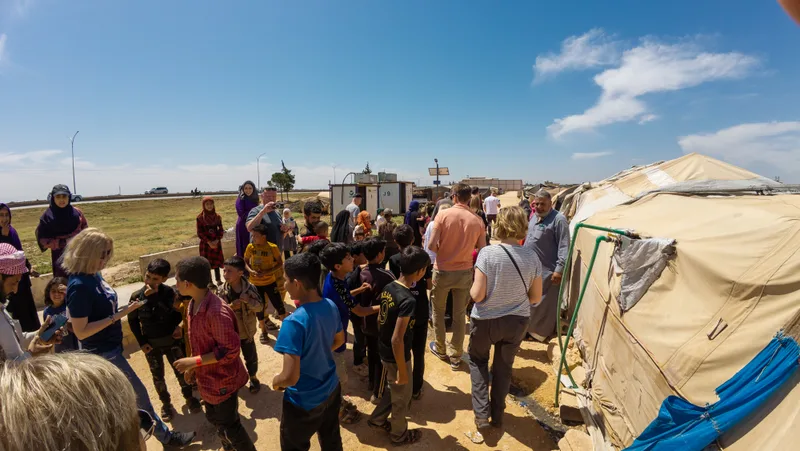
A note on imagery: people appear on this site with informed consent, as neighbors and families leading their own recovery — never as objects of pity. That standard is part of our accountability commitments.
Ways to give
Give where it's hardest, fastest
Every amount maps to something concrete — a kit, a clinic-week, a pallet position. No invented deadlines: real needs, real unit costs, and a report afterward.