Old-wiring guide · education, not fear
What's actually in your walls
Hamilton's housing stock spans 150 years of electrical practice, and most of what's old is not an emergency. This page explains the four things we're asked about most — what they are, why they matter, the signs worth calling about, and what fixing them honestly costs.
Read this first None of this is a countdown clock. Old wiring is a planning problem, not a panic problem — the right response to 'my house might have knob-and-tube' is an inspection and a written report, not a same-day rewire from whoever answered the phone first. If something in your home is actually sparking, smoking, or hot to the touch right now: switch the circuit off at the panel and call 911 or your utility. Then call us tomorrow about making it permanent.
01 · Common in homes built before ~1950
Knob-and-tube wiring
What it is
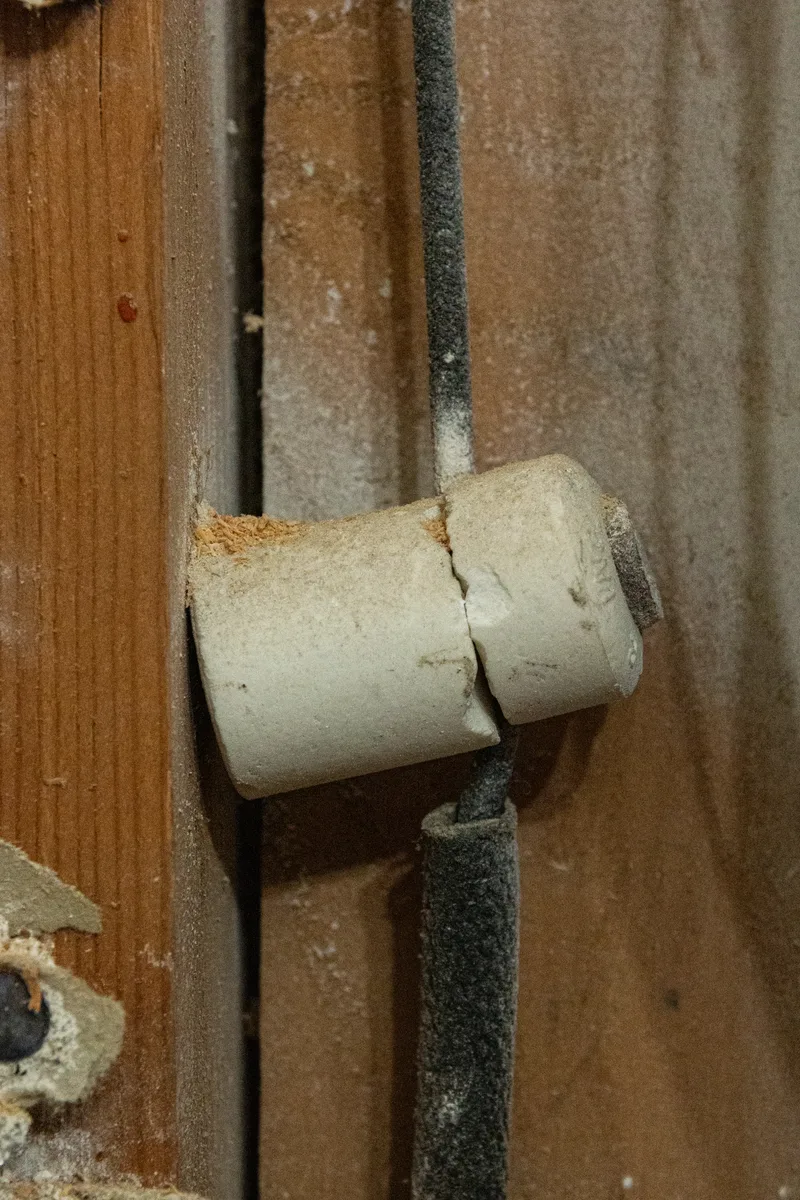
The original wiring method: separate hot and neutral conductors run on ceramic knobs and through ceramic tubes, insulated with cloth and rubber. Done well and left alone, it was good work — a century ago.
Why it matters
No ground conductor, insulation that crumbles with age and heat, and — the real killer — decades of amateur splices and buried junctions under attic insulation. Insurers increasingly decline or surcharge homes that still have it energized.
Our approach
Inspection first, always. We map what's actually live K&T versus what previous owners already replaced — most century homes are a patchwork. Then we quote the rewire by storey, so you can stage the work.
Signs worth calling about
- Two-prong outlets throughout the older parts of the house
- Ceramic knobs visible in the attic or basement joists
- Cloth-covered wires entering the panel
- An insurer or home inspector asking for an 'electrical letter'
Honest cost Inspection $280–$420. Rewires run $9,000–$19,000+ for a whole home depending on size and access — anyone quoting it sight-unseen is guessing. It is almost never an emergency; it is a planning project.
02 · Installed ~1965–1976, during the copper price spike
Aluminum branch wiring
What it is
Branch circuits run in solid aluminum instead of copper. The conductor itself is fine — the problem is at the terminations, where aluminum expands, contracts, and oxidizes against devices designed for copper.
Why it matters
Loose, oxidized terminations build resistance and heat. The fix is well understood and doesn't require tearing out walls — every termination gets a CSA-approved copper pigtail connector or an AL-rated device.
Our approach
We remediate at every accessible termination — connectors, not rip-out. A typical house has 60–120 terminations; you get a per-device price and a count before we start, plus the completion letter your insurer wants.
Signs worth calling about
- Home built or renovated between 1965 and 1976
- Cable jackets printed 'ALUMINUM' or 'AL' in the panel or attic
- Warm cover plates, flickering when appliances cycle
- A faint hot-plastic smell near outlets or switches
Honest cost $45–$70 per termination, most homes landing between $3,500 and $7,000 all-in. A full copper rewire is rarely justified — be suspicious of anyone who leads with one.
03 · Sold in Canada into the 1990s; millions installed
Federal Pioneer Stab-Lok panels
What it is
A breaker panel line whose breakers, in independent testing of the US-market equivalents, failed to trip at meaningfully higher rates than other brands. A breaker that doesn't trip isn't protection — it's a formality.
Why it matters
A breaker's whole job is to open the circuit on overload. When it doesn't, wire heats up inside your walls. The panel works fine every day right up until the one day it matters. Replacement breakers for these panels are also expensive and of debated provenance.
Our approach
We recommend replacement, not repair — a same-size panel swap keeps the cost contained. We'll show you the panel's condition with the cover off, photograph it, and let the evidence make the argument.
Signs worth calling about
- 'Federal Pioneer' or 'Stab-Lok' on the panel door
- Breakers that feel loose, or that have never once tripped in decades
- Scorching or heat discolouration around breaker stabs
Honest cost $2,200–$3,200 as a same-size swap, including the ESA permit. If you're upgrading to 200 A anyway, retiring the Stab-Lok rides along at no extra panel cost.
04 · Standard until the 1960s
60 A services & fuse panels
What it is
A 60 A service with a fuse panel was plenty for a house with a gas stove, four lights, and one radio. It is not plenty for a modern household — and screw-in fuses invite the classic hazard of over-fusing (a 30 A fuse in a 15 A circuit 'so it stops blowing').
Why it matters
The service size caps what your house can safely run at once. Insurers commonly require an upgrade at purchase, and lenders sometimes hold funds back for it. Over-fused circuits are the quiet hazard we find most often.
Our approach
Upgrade to a 100 A or 200 A breaker service depending on your plans — if an EV or heat pump is anywhere on your five-year horizon, do the 200 A once instead of paying twice.
Signs worth calling about
- Round screw-in fuses instead of breakers
- Fuses that blow when two appliances share a kitchen
- An insurance renewal asking for the service size
- Penny-sized adapters or oversized fuses in the panel (call about this one soon)
Honest cost $3,200–$4,600 to 200 A including permit and utility coordination. Not urgent in most homes — but worth scheduling before the insurer makes it urgent for you.
Not sure which of these you have?
That's exactly what the flat-fee wiring inspection answers: a panel-off look, accessible junction sampling, and a written report with photos — insurer-ready, and credited against any rewire we do.
Planned work · no sirens
Want it looked at properly?
Book the inspection, get the report, and make the decision on evidence — on your schedule, not a salesperson's.
Prefer a person? (905) 555-0177 — Sam answers weekdays 7:30–4:30.