Case type 05
Vehicle defects
Crashes caused, or made worse, by a defect in the vehicle itself.
Section 1 · Identification
- Claim is against
- The vehicle or parts maker
- Key evidence
- The vehicle and its crash data recorder
- Usual form
- Individual cases, often alongside a normal crash claim
Section 01: Overview
What a vehicle defect case is.
Most crashes are someone's driving. Some injuries, though, come from the vehicle: an airbag that did not open, a seat belt that let go, a roof that crushed, or a fuel system that caught fire.
These cases need the vehicle. Insurers often sell a totaled car at auction within weeks, so the first job is to find it and ask, in writing, that it be held.
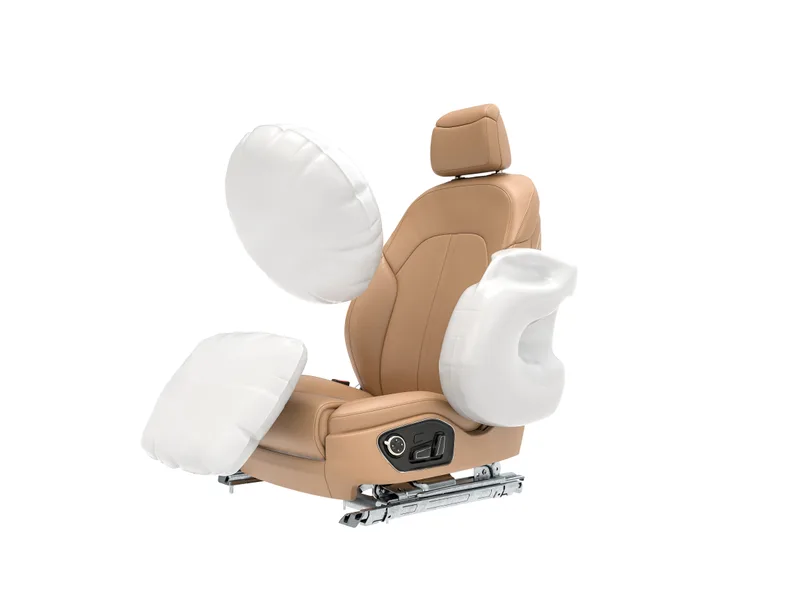
Examples of what we review
- An airbag that failed to open, or opened with too much force (example)
- A seat belt buckle that released in a crash (example)
- A roof that crushed in a rollover (example)
- A sudden loss of steering or braking (example)
- A fuel system fire after a moderate crash (example)
Generic examples on a demo site. No real product, company or lawsuit is named.
Section 02: What we look for
Most cases that move forward have these.
Missing one is not always the end. Some facts can be found in records you have forgotten about. We will tell you which ones matter for you.
Usually a fit
- Fit: A serious injury or a death in a crash
- Fit: Something in the vehicle failed: airbag, belt, seat, roof, tire, fuel system, steering or brakes
- Fit: The vehicle still exists, or you know where it was taken
- Fit: A recall or safety notice for your model helps, but is not required
Usually not a fit
- Not a fit: A crash with no vehicle failure (that is a regular crash claim, and we can refer you)
- Not a fit: The vehicle was crushed and no photos exist
- Not a fit: The failure came from aftermarket work or a bad repair (the claim may be against the shop instead)
Section 03: Records that help
What to gather, and how to get it.
You do not need any of this before you call. With your written permission, we can request most of it for you.
-
01 Where the vehicle is
The tow yard, body shop or insurer's salvage lot. Get the name and a phone number.
-
02 VIN and recall check
The 17-character VIN is on the dash and the insurance card. The federal government's free recall lookup tells you about open recalls.
-
03 Crash report and photos
The police report number, scene photos and any dashcam video.
-
04 Medical records
Emergency and hospital records describing the injuries.
Section 04: Your filing window
The vehicle deadline is usually shorter than the legal one.
Section 05: How these cases run
What to expect, honestly.
Vehicle cases are usually individual cases that rely on engineers and crash reconstruction. They often run alongside an ordinary claim against another driver. We coordinate both so you are not answering the same questions twice.
Section 06: Hold the vehicle
Two questions, and one urgent job.
Question 1
Did a defect cause the crash?
A sudden loss of steering or brakes, a tire that came apart, or a vehicle that sped up on its own.
Question 2
Did a defect make the injuries worse?
A belt that let go, an airbag that failed, a seat back that collapsed, a roof that crushed, or a fire. Lawyers call this crashworthiness.
The car remembers
Most modern vehicles have a crash data recorder that stores speed, braking and belt use from the seconds before a crash. Engineers can read it with the right tools, if the vehicle is still there.
Section 07: Questions
Questions about vehicle defect cases.
The insurance company already took my car. Is it gone?
Maybe not. Insurers often hold totaled cars for a few weeks before auction. Call us quickly and we will send a written request to hold it.
There is no recall for my car. Can it still be a defect?
Yes. Recalls only cover problems that a maker or regulator has already acted on. Many defect cases involve parts that were never recalled.
The crash was the other driver's fault. Why does the car matter?
Because a car is supposed to protect you in a crash. If a belt, airbag or roof failed, your injuries may be worse than they should have been, and the maker may share responsibility.
Free case review
Talk to someone who reads the file.
A free review takes about ten minutes. You get a plain answer: yes, not yet, or no, with the reason. Contacting us does not make you a client and costs nothing.
Mon to Fri 8 to 6 · Sat 9 to 1 · No fee unless money is recovered