Beginners
Your first class, minute by minute
Walking into a martial arts school for the first time is the hardest technique we teach. Here is exactly what happens after the door, so nothing on the other side of it is a surprise.
The first-class walkthrough
-
01 Ten minutes before
Front desk, first names, a loaner gi if your program wears one, and the two-minute tour: change rooms, water fountain, parent bench, tape line.
-
02 Bowing in
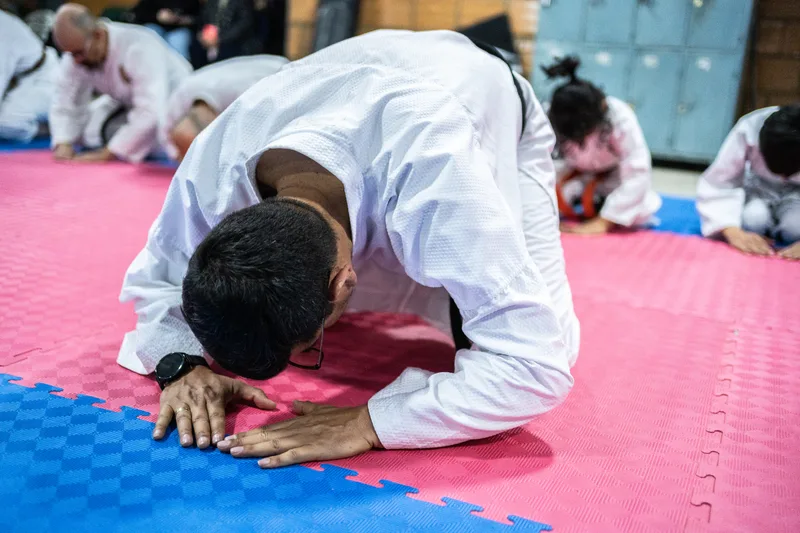
The class lines up, kneels, and bows — about twenty seconds of quiet. You copy your neighbour; nobody expects you to know anything.
-
03 Warm-up
Ten minutes of movement that doubles as technique: animal walks and breakfalls, footwork lines, easy mobility. Everything scales; the coach shows the easier version first.
-
04 The lesson
One technique, taught in layers with a partner who's done this before — the coach pairs first-timers deliberately. You'll drill it maybe thirty times. Repetition is the curriculum.
-
05 The finisher
Foundations ends with partner drills; kickboxing with pad rounds; BJJ with positional play you can sit out or scale. Kids classes end with a game they'll tell you about in the car.
-
06 Bowing out — and the honest chat
Class bows out, and a coach finds you for two minutes: what fit, what didn't, and whether this program or a different one is your right next step. No pitch, no tour of the contract binder — there isn't one.
Bring / don't bring
- Comfortable clothes & a water bottle
- Bare feet (sandals to the tape line)
- Questions — coaches love them
- A uniform — we lend you one, free
- Jewellery, long nails, strong cologne
- Any need to be fit already
Dojo etiquette
Six rules, and the reasons for them
None of this is a test — a coach or a senior student will nudge you kindly the first dozen times. The rules exist because they make the room safer and calmer, not because tradition demands theatre.
Bow at the door, bow to your partner
Not mysticism — a habit of marking the moment your attention changes. In, focused; out, released.
Bare feet on the mat, shoes never
Mat hygiene is skin hygiene. Sandals from the changing room to the tape line; feet only past it.
Nails short, jewellery off, gi clean
Your training partner's face will be nearer to your hands than you expect.
Tap early, tap often
Tapping is information, not defeat. The fastest learners tap the most and keep the most joints.
Lower rank asks, higher rank gives way
Seniors yield space on a crowded mat and answer questions without being owed anything back.
Late? Kneel at the edge
Life happens. Kneel at the tape line and the coach will wave you in at the next natural break — no laps, no theatre.
The practical bits
Getting here
318 Osprey Lane, North Vancouver. Free lot behind the building off Osprey Lane (12 stalls) and 2-hour street parking on Chesterfield. The 230 bus stops one block west.
Arriving
Come ten minutes early. A coach will meet you at the front desk, lend you a clean gi if your program wears one, and walk you through how class starts — you'll never be left guessing at the edge of the mat.
Watching first
Completely allowed. The bench along the River Mat is for families — parents are welcome to stay and watch every class, every time. No mirrored-glass mystery rooms. Come sit through a class before you ever put a toe on the mat.
Still have questions? The FAQ covers sparring policies, fitness worries, and belt costs (there are none).
The only offer we run
Try a class. Pay nothing. Decide slowly.
Any program, any trial-marked class on the schedule — no card, no contract, and an honest chat with the coach afterwards about whether this is your right room.