Skin-cancer screening
Most spots are benign. A skin check is how we know.
A full-body exam takes 10–20 unhurried minutes and answers the question your mirror can't. Here is exactly what happens, what the ABCDE letters mean, and what we do — and don't do — when something looks interesting.
The honest version of this page
The overwhelming majority of spots we examine — including the ones people lose sleep over — turn out to be entirely benign. We will never use fear to fill a schedule. The reason screening matters is simpler: the rare spot that is skin cancer is dramatically easier to treat when it is found early, and the only way to find it early is to look properly.
Basal cell and squamous cell carcinomas — the common ones — are almost always curable when caught small. Melanoma is rarer and more serious, and found early it also has excellent outcomes. Found late, everything gets harder. That asymmetry is the entire argument for a yearly exam.
What actually happens
The exam, step by step
-
A short history
Five minutes on your risk picture: past sunburns, tanning-bed use, family history, immune status, and any spots you are watching. This decides how often you should be screened — for most people, once a year.
-
The head-to-toe exam
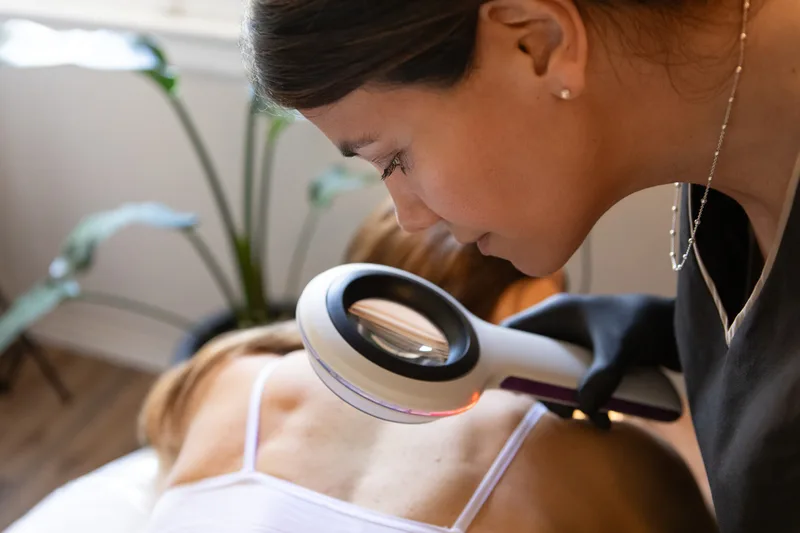
In a gown, in a private room, a board-certified dermatologist examines your skin systematically — scalp, face, ears, trunk, arms, legs, palms, soles, and between toes. You choose what stays covered; a chaperone is always available. The exam itself takes 10–20 minutes.
-
Dermoscopy on anything interesting
A dermatoscope — a polarized magnifier — lets us see pigment structure invisible to the naked eye. It is how we tell the harmless many from the suspicious few without cutting anything.
-
Photos of watch-list spots
Spots that are benign-but-worth-tracking are measured and photographed, so next year's exam compares against evidence instead of memory.
-
A biopsy only if warranted
If a spot needs testing, a small sample is usually taken the same visit under local anesthetic — a few minutes, a small bandage. Pathology results come back in about a week, and we call you either way.
Dignity notes, because people quietly worry about them: you are gowned throughout, only the area being examined is uncovered, you choose what stays covered, and a chaperone is available for any exam — no reason needed.
Your home checklist
The ABCDEs of a mole worth showing us
Check your skin about once a month — after a shower, with a mirror or a partner for your back. One letter alone doesn’t diagnose anything; it earns a spot a proper look under the dermatoscope.
-
A is for Asymmetry
One half of the spot doesn't match the other half in shape.
-
B is for Border
Edges are ragged, notched, or blurred instead of smooth.
-
C is for Color
More than one shade — browns, black, pink, white, or blue in the same spot.
-
D is for Diameter
Larger than about 6 mm — a pencil eraser — though melanomas can be smaller.
-
E is for Evolving
The most important letter: any change in size, shape, color, or feel over time.
Plus the “ugly duckling” rule: a spot that looks different from all of your other spots — bigger, darker, lonelier — deserves a look even if no ABCDE letter fits. Your pattern is the baseline; the outlier is the question.
Who should book a yearly exam
A reasonable rule: everyone benefits from a baseline exam; a yearly rhythm earns its keep if any of these apply. Higher-risk patients leave with a schedule matched to their skin — sometimes every six months, occasionally every three.
- Fair skin that burns easily, or red/blond hair
- Blistering sunburns in childhood, or years of outdoor work
- Tanning-bed use, at any point, ever
- More than ~50 moles, or moles that run atypical in your family
- A personal or family history of melanoma or other skin cancer
- A suppressed immune system (transplant, certain medications)
Priority track — not an emergency
A new, changing, or bleeding spot deserves a prompt look — not panic. We hold priority slots so these visits are seen within about five business days. That is a medically appropriate timeline: most changing spots turn out to be benign, and the ones that are not are still best served by a careful exam, a dermatoscope, and a biopsy — none of which an emergency room does better.
The exceptions — go to emergency care instead
- A spreading rash with fever, blistering, or peeling skin — especially if your mouth, eyes, or genitals are involved
- Sudden swelling of the lips, tongue, or throat, or any trouble breathing after a sting, food, or new medication
- A rapidly spreading area of hot, painful, red skin with fever or chills (possible skin infection)
- A severe burn, or any burn involving the face, hands, or joints
These need same-day emergency or urgent care — not a dermatology appointment. Go to the nearest emergency department or urgent care first; we are glad to follow up afterward. Everything else in dermatology — including a changing mole — is handled properly by a prompt appointment, not an ER visit. Questions? Call us at (734) 555-0142.
If we do find something
Biopsy, same visit
A small sample under local anesthetic — a few minutes, a small bandage. We tell you what we are testing for and what each answer would mean, before you decide.
Results in ~a week
A dermatologist reads every report and we call you either way — benign results are still results, and you should not have to chase them.
A plan the same week
If treatment is needed: most removals happen here in clinic; cosmetically sensitive sites may be referred for Mohs surgery. You will never hold a diagnosis without also holding a plan.
Appointments
Book the exam you’ve been meaning to book.
Full-body exams are 30-minute visits with a board-certified dermatologist — $165 self-pay, or billed to your plan like any specialist visit. Worried about one specific spot? Use the priority track instead.