Plain-language guides to the conditions we treat every day: what each one is, what care honestly looks like, and when to book — including which concerns go on the priority track. No cure promises, because dermatology doesn't work that way.
Acne
Blocked, inflamed oil glands — the most common skin condition there is, in teens and well into adulthood.
What it looks like
Whiteheads, blackheads, tender red bumps, or deeper painful cysts on the face, chest, shoulders, or back. Scarring and dark marks where older spots healed.
What treatment honestly looks like
A stepwise plan: medical-grade topicals first, then oral options (antibiotic courses, hormonal therapy, isotretinoin for stubborn cystic acne) when needed. Most plans take 8–12 weeks to show real change — anyone promising clear skin in a week is selling something.
When to be seen
Book a routine visit whenever acne bothers you — and sooner rather than later if it is leaving scars or dark marks, because scarring is easier to prevent than to fix.
A dry, itchy, easily-irritated skin barrier that flares and settles in cycles. Common in children; plenty of adults have it too.
What it looks like
Itchy, red-to-brownish patches that get worse with scratching — often in elbow creases, behind the knees, on hands, eyelids, or the neck. Skin that stings with fragranced products.
What treatment honestly looks like
Barrier repair first (the right moisturizer, used the right way), then prescription anti-inflammatories for flares. For moderate-to-severe eczema, newer biologic and non-steroid options can change lives. Eczema is managed, not cured — the goal is long comfortable stretches between flares.
When to be seen
Routine visit for anything that itches for more than two weeks, disturbs sleep, or keeps coming back. Weeping, honey-crusted patches can mean infection — mention it when booking and we will fit you in sooner.
An immune condition where skin cells turn over too fast, building well-defined scaly plaques. It is not contagious, and it is very treatable.
What it looks like
Thick, sharply-bordered pink or salmon plaques with silvery scale — classically on elbows, knees, scalp, and lower back. Nail pitting or lifting. Sometimes joint stiffness (psoriatic arthritis — worth telling us about).
What treatment honestly looks like
Topicals and medicated shampoos for limited disease; light therapy, oral medications, or biologics when more of the body is involved. Modern treatment can keep most people's skin clear or almost clear — 'clear' and 'cured' are different words, and we will always use the honest one.
When to be seen
Routine visit for new or spreading plaques, scalp scale that will not shift, or nail changes. Mention joint pain or morning stiffness when booking — it changes the plan.
A tendency to flush and stay red across the cheeks, nose, and chin, sometimes with acne-like bumps or irritated eyes.
What it looks like
Persistent central-face redness, visible small vessels, stinging with skincare, flushing with heat, alcohol, or spicy food. Bumps and pustules in some people.
What treatment honestly looks like
Trigger mapping, barrier-gentle skincare, prescription topicals or short oral courses for bumps, and vascular laser for fixed redness and vessels. Rosacea is controlled rather than cured — most people get to a face that behaves predictably.
When to be seen
Routine visit when redness or bumps persist for more than a few weeks or affect how you feel in a meeting or a photo. Eye grittiness or redness alongside it is worth mentioning when you book.
Most moles are harmless collections of pigment cells. The job is telling the stable many from the rare one that is changing.
What it looks like
Any spot that is new in adulthood, growing, itching, bleeding, or simply looks different from your other moles — the 'ugly duckling'. The ABCDE letters (asymmetry, border, color, diameter, evolving) are a good home checklist.
What treatment honestly looks like
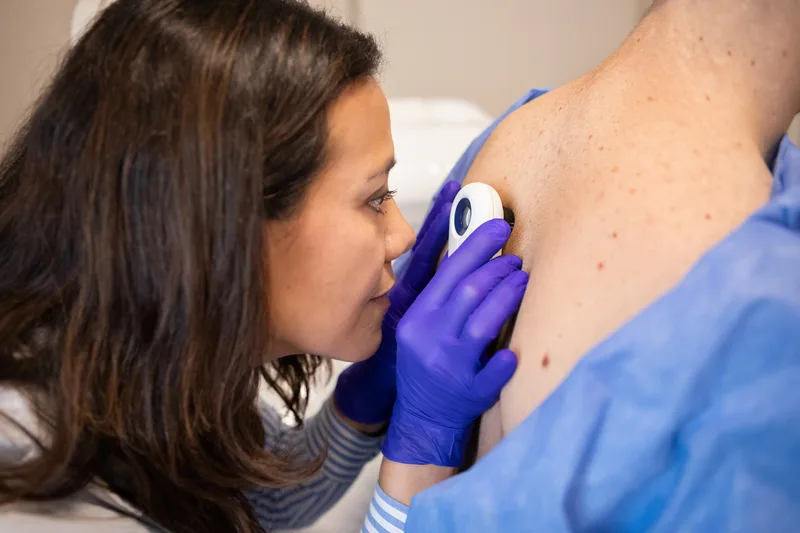
Dermatoscopic exam — a magnified, polarized look at the structures inside a spot. Stable, benign spots are photographed and watched. Suspicious ones get a small biopsy, usually done the same visit, with pathology results in about a week.
When to be seen
A new, changing, or bleeding spot books on our priority track — seen within about five business days. Not an emergency, and not something to sit on for six months either.
The most common cancers there are — and among the most treatable when found early. Basal cell and squamous cell grow locally; melanoma is the rarer, more serious one.
What it looks like
A pearly or scabbing bump that will not heal, a scaly persistent rough patch, a sore that bleeds and re-crusts, or a dark spot that is changing. Often on sun-exposed skin: face, ears, scalp, forearms.
What treatment honestly looks like
Diagnosis by biopsy, then treatment matched to the type: surgical removal for most, referral for Mohs surgery on cosmetically sensitive sites, and a follow-up schedule so nothing new is missed. Found early, basal and squamous cell cancers are almost always curable; early melanoma has excellent outcomes too.
When to be seen
Priority track for any non-healing or changing lesion. Routine annual full-body exams if you have fair skin, heavy past sun, many moles, or a family history.
Stubborn but harmless viral growths — extremely common in kids, common enough in adults.
What it looks like
Rough, raised bumps on hands, feet (often tender with pressure), or knees; molluscum shows as small smooth pearly bumps, mostly in children.
What treatment honestly looks like
Freezing (cryotherapy), prescription topicals, or minor procedures for holdouts. Honest expectation: warts often need several treatments over a few months, and some resolve on their own — we will tell you when waiting is the reasonable option.
When to be seen
Routine visit when they spread, hurt, or bother you. Sooner for anything on the face you are tempted to treat with a drugstore acid — please don't.
Shedding and thinning have many causes — pattern hair loss, stress shedding, autoimmune patches, scarring types — and the treatment differs completely between them.
What it looks like
Widening part, more hair in the drain, smooth round bald patches, or itching and flaking with the loss. Photos over time help more than any single glance.
What treatment honestly looks like
Diagnosis first: scalp exam, sometimes bloodwork or a small scalp biopsy. Then honest options — proven topicals and orals for pattern loss, steroid injections for patchy autoimmune loss, urgency for scarring types because follicles do not come back. No miracle serums here.
When to be seen
Routine visit for gradual thinning. Book sooner (mention it in notes) if loss is patchy, rapid, or the scalp is sore or scarred — scarring alopecia is the one that cannot wait months.
Itchy welts that appear, migrate, and vanish within hours — an over-reactive histamine response, most often without a single findable cause.
What it looks like
Raised pink welts anywhere on the body, each lasting less than 24 hours before moving on. When it continues past six weeks it is called chronic urticaria.
What treatment honestly looks like
Structured antihistamine dosing controls most cases; stubborn chronic hives have good second-line options. Extensive allergy testing is usually not the answer — we will say so rather than order it.
When to be seen
Routine visit for hives that keep returning past a couple of weeks. Lip, tongue, or throat swelling or any breathing trouble is an emergency — that is a 911 call, not an appointment.
Rough, persistent 'sandpaper' patches on sun-exposed skin — precancerous changes worth treating before they become something more.
What it looks like
Gritty pink or flesh-colored rough spots on the face, scalp, ears, and forearms that flake, sting, and return in the same place.
What treatment honestly looks like
Cryotherapy for scattered spots; prescription field treatments or light-based therapy when an area is peppered with them. Plus a sun plan that is actually livable.
When to be seen
Routine visit — but do book; treating these early is one of the clearest wins in dermatology. Any spot that thickens, grows fast, or hurts moves to the priority track.
A new, changing, or bleeding spot deserves a prompt look — not panic. We hold priority slots so these visits are seen within about five business days. That is a medically appropriate timeline: most changing spots turn out to be benign, and the ones that are not are still best served by a careful exam, a dermatoscope, and a biopsy — none of which an emergency room does better.
The exceptions — go to emergency care instead
A spreading rash with fever, blistering, or peeling skin — especially if your mouth, eyes, or genitals are involved
Sudden swelling of the lips, tongue, or throat, or any trouble breathing after a sting, food, or new medication
A rapidly spreading area of hot, painful, red skin with fever or chills (possible skin infection)
A severe burn, or any burn involving the face, hands, or joints
These need same-day emergency or urgent care — not a dermatology appointment. Go to the nearest emergency department or urgent care first; we are glad to follow up afterward. Everything else in dermatology — including a changing mole — is handled properly by a prompt appointment, not an ER visit. Questions? Call us at
(734) 555-0142.
Fig. 04 — Dermoscopy — structure, not guesswork
Not sure which box your skin fits? That is
normal — half of dermatology is telling similar-looking things
apart. Book “something else” and describe what you see; the exam
will do the sorting.