FAQ
Straight answers about concrete.
The questions we get on almost every site visit, grouped the way people ask them. If yours is not here, call the office; we would rather answer it before you sign than after.
4 questions
Cracking
Will my new concrete crack?
Almost certainly a little, and that is normal. Concrete shrinks as it cures. Control joints give that shrinkage a straight, planned place to crack, inside a groove where you will barely see it.
What is a control joint?
A groove cut or tooled into the slab, about a quarter of its depth. It makes a weak line on purpose, so the slab cracks there instead of across the middle. On a 4 in slab we space them no more than 10 ft apart.
Which cracks should worry me?
Cracks that cross a panel instead of following a joint, open wider than about 1/8 in, or have one side higher than the other. Those are covered by our two-year workmanship warranty, and we come look.
Do fiber and rebar stop cracks?
No. They hold the pieces together and keep a crack tight and level if one forms. Joints control where cracks happen; steel controls what happens after.
4 questions
Curing
When can I walk and drive on it?
Feet after 24 to 48 hours, cars after 7 days, heavy trucks after 28 days. Below about 50°F add two or three days to each. Your dates go on the cure card.
Should I water my new concrete?
Not usually. We spray a curing compound that holds the water in. On a very hot, windy day we may ask you to mist it; we will tell you if so.
What if it rains on pour day?
We watch the forecast and move the date rather than pour into rain. Rain on fresh concrete washes cement off the top and leaves a weak surface that flakes later. Once it is finished and sprayed, a shower is fine.
Why does it look blotchy at first?
Concrete dries unevenly for a few weeks, so darker patches are normal. It evens out over the first month or two.
Printed on pour day
The cure clock
Concrete hardens by chemistry, not by drying. These are the dates on the card we tape to your door.
Curing questionsDay
0
Pour day
Placed, finished and sprayed with curing compound. Joints are cut within hours. Keep kids, pets and sprinklers off.
Day
1-2
Feet
Walk on it with care after 24 to 48 hours. No bikes, no dragging grills or furniture across it.
Day
7
Cars
Drive and park passenger cars after 7 days. Keep tires off the outer edges for another week.
Day
28
Full strength
Close to full design strength. Moving vans and dumpsters are fine, and the first sealer can go on.
Cool weather slows everything down. Below about 50°F, add two or three days to each step. We write your actual dates on the card.
3 questions
Sealing
Do I need to seal my concrete?
Stamped and colored work, yes. Broom finish, it is optional but smart in a salt climate. A penetrating sealer keeps water and salt from soaking in.
When and how often?
First coat after at least 28 days of curing. Then every 3 to 5 years for penetrating sealer on broom and aggregate, every 2 to 3 years for the acrylic on stamped work. Always a dry day above 50°F.
Will sealer make it slippery?
Penetrating sealer does not change the texture. The glossy acrylic on stamped work can be slick when wet, so we mix in an anti-slip grit.
4 questions
Freeze-thaw
Can you pour in cold weather?
Only when nights stay above freezing and the ground is not frozen. Late in the season we use blankets and a warmer mix. Outdoor flatwork stops around mid-November most years.
Can I salt my new driveway?
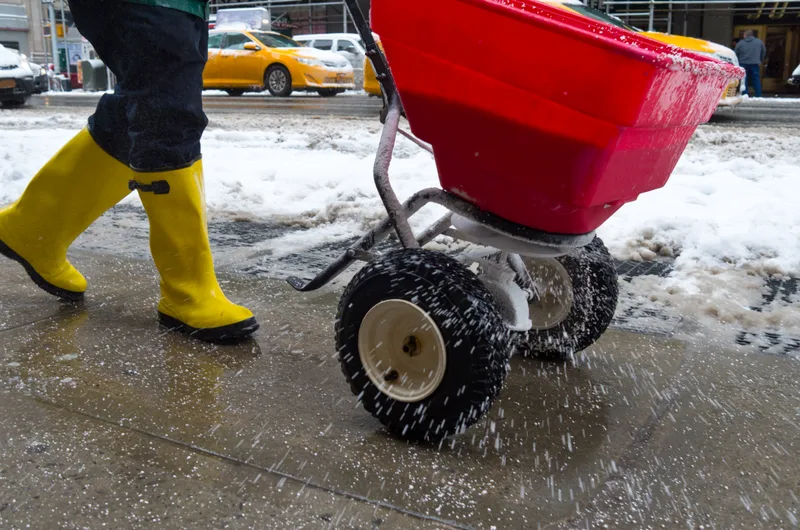
Not the first winter. Use sand for traction and shovel early. After the first winter, use calcium-magnesium acetate or calcium chloride sparingly, and never fertilizer-based ammonium deicers, which attack concrete.
What is scaling, and is it covered?
Scaling is the top layer flaking off after water freezes inside it. A proper air-entrained mix and finish prevent most of it, and flaking from our finish is covered. Damage from deicer used the first winter is not.
Why is air-entrained concrete better here?
It holds millions of tiny air bubbles that give freezing water room to expand. Non-air-entrained concrete outdoors in Michigan flakes, often within a couple of winters.
5 questions
Price and process
Why does your price differ from what I read online?
National averages leave out base prep, steel and tear-out, or mix in warm-climate prices. Ours include the gravel base, steel, joints and cure compound, and list tear-out separately so you can compare bids line by line.
Is there a minimum job?
Yes, $2,400. A truck, a crew day and the forms cost the same for a small pad as for a big one, so most pours under about 250 sq ft land there.
Do you take a deposit?
10% to hold a pour date. The balance is due when the job is done and you have walked it with us.
How soon can you start?
In spring we often book four to six weeks out. In late season we pour until nights get too cold, then book the spring calendar over the winter.
Do you do asphalt, pavers or epoxy floors?
No. We only pour and finish concrete. We will happily point you to good people for those.
Next step
Still have a question? Ask it on site.
Every quote starts with a visit from the person who prices the job. Bring the questions; we bring the sample boards.