A salon owner's guide to choosing a marketing agency in 2026: what a good one must understand about chairs, rebookings and local search — plus red flags.
Why a salon needs an agency that gets salons
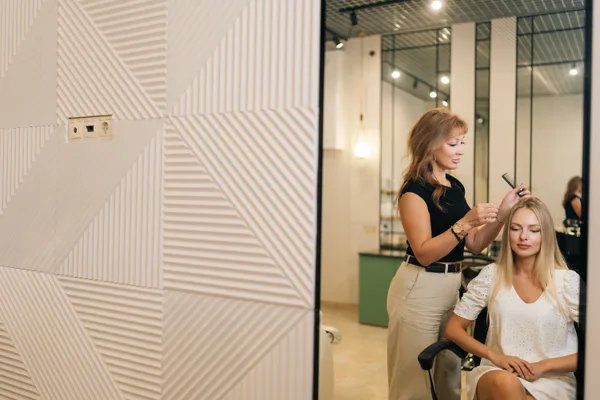
Most marketing agencies treat a hair salon like any other local business: build a site, run some ads, chase "leads." That framing quietly costs you money, because a salon doesn't run on leads — it runs on a full appointment calendar and the rebooking behind it.
The economics are specific to the chair. A color client comes back every few weeks, not once, so a single retained client is worth far more over a year than the one-time ticket a cut-and-go customer leaves behind. Boulevard's salon data found that first-time clients who book online return for a second visit about 78% of the time, versus around 39% for walk-ins. The whole game is repeat visits per chair, not a one-time transaction. An agency that only counts "new client inquiries" and stops there is optimizing the wrong number.
Then there's the no-show problem, which is a marketing problem disguised as an operations one. No-show rates at salons commonly run into the double digits, and empty slots plus last-minute cancellations quietly bleed thousands of dollars a month. Online booking with deposits and automated reminders measurably cuts that — Phorest, among others, has reported no-shows falling sharply where booking deposits are used. If your agency's plan ends at "get the phone to ring," it ignores half of where salon revenue actually leaks.
So the first filter is simple: can they talk fluently about chair utilization, rebooking rates and no-shows — or do they only talk about clicks and impressions? If it's the latter, they'll build you a campaign that looks busy and a calendar that stays patchy.
The channels that actually fill chairs (and the ones that just look good)
A salon-literate agency knows the order clients actually move in, and builds to it. The pattern is well documented for 2026: most salon bookings start with a Google search — "hair salon near me," "balayage near me," "best hair salon [city]" — and a large share of those clicks land in the Google Maps local pack before a website is ever opened. Industry sources put the share of clients who begin on Google somewhere in the 70–80% range, with map-pack listings shaping the majority of local salon decisions.
But discovery isn't the same as the decision. Once a client finds you on Google, they validate you on Instagram and through reviews before they book. Reviews are not a vanity metric here — survey after survey shows the overwhelming majority of consumers read reviews before choosing a local business, many won't seriously consider one rated below about four stars, and recent reviews carry far more weight than older ones. Instagram is where they confirm your work is consistent and the room feels like somewhere they want to sit.
So the channels that fill chairs are a loop: local SEO and a strong Google Business Profile to get found, Google Ads to capture high-intent "ready now" searches, a fast booking-focused website to convert the click, reviews to win the comparison, and email plus reminders to drive the rebooking. A good agency builds these as one connected system. A weaker one sells you the channel they happen to specialize in — usually social posting — and leaves the booking path, the map pack and the review engine untouched. Pretty content with no path to a booked appointment is the most expensive thing in salon marketing.
Service mix and seasonality they should already know
A salon's calendar isn't flat, and an agency that's run salon campaigns before will plan around that instead of being surprised by it. Demand spikes ahead of the obvious moments — holidays, weddings and prom, back-to-school, New Year — and color, balayage, extensions and keratin carry different margins, retention curves and rebooking intervals than a basic cut. Your highest-value, highest-retention services deserve their own ad groups, their own landing pages and their own SEO pages. A generic "haircut" campaign leaves the profitable work on the table.
Ask a prospective agency how they'd weight spend across services and across the year. The answer should be specific: push color and balayage where your margins and rebooking are strongest, lean into gifting and event-driven services before peak seasons, and protect the calendar with deposits and reminders when no-show risk is highest. If they can't sketch that without a discovery call, they haven't run this vertical.
There's a Canadian wrinkle worth naming too. Demand patterns, the wedding and event calendar, and even weather-driven booking dips differ by region, and a salon in Calgary doesn't run the same seasonal playbook as one in Toronto or Halifax. An agency that understands your local market — not just "salons" in the abstract — will tune campaigns and budgets to your actual neighbourhood and clientele rather than a borrowed template. Specificity here is a strong signal you're talking to people who've done this before.
How to evaluate one: make them prove the booking, not the click
The single most useful question you can ask: "How will I know which marketing produced a booked appointment?" A good agency has a real answer involving call tracking, form tracking and conversion tracking wired up from day one, tied back to the campaign, keyword or channel that drove it. A weaker one will redirect to "engagement," "reach" or "impressions" — metrics that never tell you whether a chair got filled.
This matters because plenty of salon clients still call before they book, and an unanswered or fumbled call is a lost appointment that no dashboard catches unless someone set up call tracking. Ask how they'd handle missed calls, how they'd attribute a phone booking, and how they'd report your true cost per booked client — broken down by service, ideally, so you can see whether your colour clients or your cut clients are cheaper to acquire and worth more over time.
Press on rebooking too. Ask how they'd grow repeat visits, not just first visits — because retention, not constant new-client buying, is where salon profit compounds. The right answer involves email, reminders and win-back flows for lapsed clients, all measured. If the agency can explain how they'd separate first-visit cost from lifetime value, and show you a sample report instead of describing one, you're dealing with operators. Vague reporting promised "once we get going" is the most common place these relationships quietly fail.
AI search is now part of the brief
A 2026-ready agency should have an answer for AI search, because a growing share of clients now ask ChatGPT, Gemini, Google's AI Overviews or Perplexity "who's the best hair salon near me?" or "recommend a balayage specialist in [city]" instead of scrolling a results page. The assistant names a few salons and the client books one. If you're not among the names, you don't get considered — and there's no second page to climb to.
The encouraging part is that the foundations overlap heavily with what already wins on Google: a clean, well-structured website, an accurate and active Google Business Profile, consistent business information across the web, and a steady flow of recent, genuine reviews. AI assistants lean on the same signals of trust and freshness that the consumer-review research keeps highlighting — recent reviews count for more than old ones. So an agency that does local SEO and reviews properly is already most of the way to AI visibility.
What you're checking for is whether they treat AI search as a deliberate part of the plan or hand-wave it. Ask how they'd make your salon more likely to be recommended by an AI assistant, and what they'd measure. You won't get a guaranteed-rankings answer — nobody honest gives one, since AI visibility shifts and compounds over time — but you should hear a concrete approach grounded in structure, reviews and accurate listings. An agency that's never thought about it is planning for the search behaviour of three years ago.
Red flags and the ownership question
A few patterns reliably signal an agency that will cost you more than it returns. Long lock-in contracts are the biggest one: if the work is good, they don't need a year of your money guaranteed. Month-to-month keeps an agency honest, because they have to earn the next month every month.
Watch for proprietary platforms you can't take with you. If your website lives on their CMS, your ad accounts are in their name, or your client list sits in a tool only they can access, you don't own your own growth — and leaving means starting from zero. You should own your website, your brand assets, your Google Ads and Business Profile accounts, and your client data outright. Confirm that in writing before you sign.
Other flags: guaranteed #1 rankings (impossible to promise honestly), pricing locked into rigid "packages" that ignore your market and service mix, a separate vendor for every channel so nobody owns the booked-appointment outcome, and reporting that only surfaces when you ask for it. And be wary of any agency that won't integrate with the booking software you already use — Vagaro, Square Appointments, Boulevard and the like. A real partner builds online booking into your site and works alongside your existing calendar; they don't force you to rip out the system your front desk already runs on.
Where SearchPod fits — and where it doesn't
We'll be straight about this rather than claim to be the best salon agency in the country. SearchPod is a Canadian full-funnel performance-marketing agency, and a salon owner should hire us for specific, checkable reasons, not a slogan.
What we line up well against the criteria above: we run your website, Google Ads, SEO, AI search, email and reviews as one team instead of five disconnected vendors, so a single group owns the booked-appointment outcome end to end. We set up call, form and conversion tracking from day one and report your true cost per booked client — and we build for rebookings and chair utilization, not just first visits, because that's where salon profit actually lives. You keep full ownership of your website, ad accounts and client data. We're month-to-month with transparent reporting, and we build online booking into your site and work alongside tools like Vagaro, Square Appointments and Boulevard rather than locking you into ours. (If you want the mechanics of how that system is built, our companion piece on the hair salon marketing system walks through it in detail — this guide is about choosing well, whoever you pick.)
Where we're not the fit: if your chairs are already booked solid and you just want someone to post to Instagram a few times a week, you don't need a full-funnel agency yet, and we'll tell you so. The honest test for any agency — us included — is whether they tie their work to filled chairs and rebookings you can verify. Ask hard questions, make them prove the booking, and hire the team that answers in specifics.