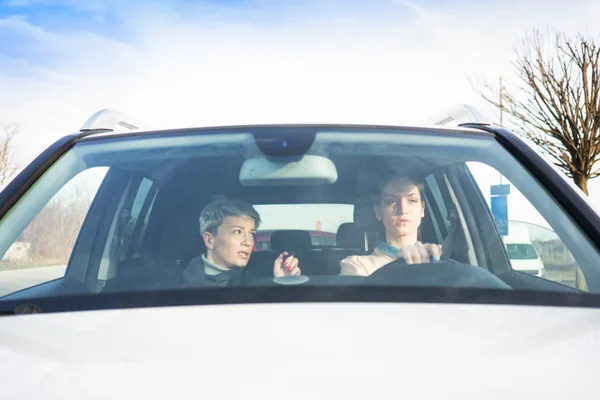
The channels, funnel stages, and economics that actually book driving lessons in 2026 — built around how parents and teens really choose a school.
Start with who actually buys: a parent on a phone, deciding in minutes
Almost every driving-school marketing decision flows from one fact about the buyer: in the teen segment, the person paying is rarely the person learning. A parent searches "driving school near me" on a phone, scans the map pack, reads a few recent reviews, checks whether your pass rate or licensing benefit is obvious, and tries to book. If that sequence stalls anywhere, they tap the next listing. The whole evaluation takes minutes, and it happens before you ever know they existed.
That changes what your marketing has to do. You're not running a brand-awareness campaign. You're intercepting a high-intent local search and removing every reason to hesitate — distance, trust, price clarity, ease of booking — faster than the school ranked above you. The two buyer types behave differently, too. Parents of teens are cautious and reassurance-driven; they want certified instructors, safety, and a clean licensing path. Adult learners — new immigrants, license re-takers, nervous drivers — are more self-directed and book closer to the moment of need, often for road-test prep on a tight deadline.
Get specific about which of these you want to fill the calendar with, because they live in different searches and respond to different messages. A system built around "more students" wins nobody in particular. A system built around "parents of 15- and 16-year-olds in these three neighbourhoods, plus adult road-test prep on weekends" gives every channel a clear target — and gives you a way to measure whether it's working.
The economics: what a student is worth, and what you can pay to win one
Before you spend a dollar on ads, you need two numbers, and you can pull both from your own books rather than an industry average. The first is what an enrolled student is actually worth to you: take your typical teen package — classroom theory plus behind-the-wheel hours — and add the realistic add-ons that follow, like extra road-test prep or refresher lessons. The second is what it currently costs you to acquire one, which means tracking spend against actual enrollments, not clicks or leads.
The rule of thumb worth internalizing is that acquisition cost should stay well under a fraction of what a student is worth before a channel scales profitably. Driving schools have an advantage here. Most students stay with one school until they're licensed, so a single enrollment usually means a full package, not a one-off lesson. That pushes true value above the first transaction, especially when you upsell advanced or refresher modules — which gives you more room to compete for the click than a school thinking only about the first sale.
This is why "cheapest cost-per-click" is the wrong target. A campaign that produces expensive clicks but books full packages beats a campaign with cheap clicks that books nothing. You measure the system on cost per enrolled student and cost per booked lesson, then work backward. Once you know what a package is worth and what you're comfortable paying to win it, every channel decision — bid, neighbourhood, course, off-season push — becomes a math problem instead of a guess. Run your own numbers; the exact figures vary too much by market and course mix to borrow someone else's.
The four channels, and the job each one does
A working driving-school system runs four channels that feed one booking calendar. They are not interchangeable — each captures demand at a different stage.
Google Ads is the fast channel. It puts you at the top for "driving lessons near me," "drivers ed near me," and "road test prep near me" the day it launches, which is why it carries the load while everything else compounds. Structure it by course — teen driver-ed, behind-the-wheel, adult lessons, road-test prep — because those buyers convert differently and deserve different landing pages.
Local SEO and your Google Business Profile are the channel that pays you back later. The map pack is where most "near me" searches resolve, and ranking there means you win clicks you'd otherwise rent from ads. It's slower — think months of optimized course pages, neighbourhood pages, and a tuned profile — but durable.
Reviews are the trust channel, and in this vertical they're decisive. More on that below, but treat review generation as a system, not a hope.
AI search is the emerging channel. When a parent asks ChatGPT, Gemini, or Google's AI Overviews for the best driving school nearby with good reviews, the assistant names a short list. Being on it is becoming its own discipline, and it's built on the same foundations — strong reviews, clear structured content, real local authority — that power SEO. The point of running all four together is that they reinforce each other: ads buy time while SEO and reviews build the moat, and AI search rewards the schools that already did the work.
The funnel: search to inquiry to booked lesson to full package
Map your marketing to the four stages a student actually moves through, because each stage has its own leak.
Stage one is the high-intent search. The job here is visibility and relevance: be in the map pack and the ad block for the exact course someone wants, in the neighbourhood they're searching from. A leak at this stage is invisible — you simply never appear.
Stage two is the inquiry: a call, a form, or a tap on your online booking. This is where most schools quietly lose money. A parent who has to phone during business hours, leave a voicemail, or pay by cheque will book the school that lets them reserve and pay in two taps. Online scheduling isn't a convenience feature; it's the conversion mechanism. And because many parents still call before enrolling, a missed call is a lost enrollment — an automatic text-back on unanswered calls recovers students who'd otherwise dial the next listing.
Stage three is the booked lesson — the inquiry turned into a slot on an instructor's calendar. Reminders and easy rescheduling protect it from no-shows.
Stage four is the full package and the road test. One lesson should become a complete licensing journey, then a referral. This is where email earns its keep: confirmations, reminders, package nurtures, and road-test-prep prompts that move a one-off learner through to a finished license. Knowing your stages lets you find the specific leak. "We get inquiries but they don't book" is a stage-two problem; "we don't get inquiries" is a stage-one problem. They have completely different fixes — and guessing wrong wastes a quarter.
Why reviews are the highest-leverage asset you have
In most local businesses reviews matter. In driver training they're close to the whole game, because a parent is handing you their teenager and a few hundred dollars on the strength of strangers' experiences. The pattern is consistent across local-consumer research: most people read reviews before choosing a local business, ratings act as a filter that screens out anything below a strong star average, and a single bad recent review can quietly cost you the inquiry. You don't need a precise percentage to act on this — the direction is unambiguous, and it points to running reviews deliberately.
Two details change how you should run them. First, recency matters intensely. A wall of five-star reviews from two years ago reassures no one; a parent wants to see that students passed last month, not in some earlier era. That means review generation has to be continuous, not a one-time push — a friendly, well-timed request to every student and parent right after a pass, every month, indefinitely.
Second, reviews now feed two systems at once. They influence your map-pack ranking and they shape what AI assistants surface when someone asks for a top-rated school. The same engine that builds trust on your listing also improves where you rank organically and whether an assistant names you. Few investments in this vertical compound across that many channels, which is exactly why a steady review flow belongs at the centre of the system rather than as an afterthought.
Beat the seasonality instead of riding it
Driving-school demand has a predictable shape, and most schools let it run their year instead of managing it. The teen rush concentrates around summer and back-to-school: families enroll the summer before a teen reaches the eligible age so they can sit the knowledge test as soon as possible, and behind-the-wheel demand stays high through fall — often to the point that lesson scheduling backs up by weeks during the peak. Then winter and early spring go quiet, instructor calendars empty, and schools scramble.
The system answer is to run two motions. During the peak, your job is capture and capacity: ads and SEO catch the surge, and your booking flow has to handle volume without losing inquiries to phone tag. In the off-season, your job is demand generation and reactivation — and this is where email and the adult segment matter most. Adult learners and road-test-prep students don't follow the teen calendar, so you can market to them year-round to smooth the troughs. Win-back emails to inquiries who never enrolled, nudges to learners who took one lesson and drifted, and offers timed to the slow months keep instructors working in February instead of waiting for May.
The schools that grow steadily are the ones that treat the off-season as a marketing opportunity rather than a fact of life. The demand exists across the whole year; it just shifts segments. A system built only for summer leaves half the calendar — and half the revenue — on the table.
Use the licensing rules as marketing, not fine print
Driver training is a regulated, locally specific product, and the regulation is a selling point if you put it to work. In Ontario, for example, only driving schools approved by the Ministry of Transportation can deliver the official Beginner Driver Education (BDE) course, and completing it carries two concrete benefits parents care about: it can shorten the waiting period before the G2 road test, and many insurers offer premium discounts to certified graduates. Other provinces and states have their own graduated-licensing structures and recognized-course programs. The specifics vary, but the pattern holds — official certification is both a trust signal and a tangible financial benefit to the family.
Most schools bury this in a footer. The system surfaces it. Your ads should reference the licensing benefit a course unlocks, not just the lesson. Your landing pages should answer the questions a parent is actually asking — will this get my teen licensed faster, and will it lower our insurance — in plain language tied to the right local program. Your content and Google Business Profile should make your certification status unmissable. This also feeds AI search: when an assistant is asked which school offers the recognized course in a city, it pulls from clearly stated, well-structured information about exactly that.
The broader principle is that in a regulated local vertical, accuracy and specificity outperform generic copy. "Certified instructors, real licensing benefits, in your area" beats "learn to drive today" every time — and it's the kind of claim you can actually stand behind. Confirm the current rules for your own province or state before you put a number on the benefit; the structure is stable, the details change.
Measure the system on enrollments and one connected dashboard
A system you can't measure is just spending. The discipline that separates schools that scale from schools that plateau is tracking every channel back to the only outcomes that pay the bills: package enrollments and booked lessons. That requires call tracking, form tracking, and conversion tracking wired up from day one, so a phone call from a Google Ad and a form fill from organic search both land in the same view as the bookings they produced.
With that in place, three numbers run the system. Cost per enrolled student tells you whether a channel is profitable against the package value you established earlier. Course-level return — tracking driver-ed, behind-the-wheel, adult lessons, and road-test prep separately — tells you which students are actually worth winning, because they rarely cost or earn the same. And source attribution tells you which campaign, keyword, or neighbourhood produced each inquiry, so you can put more money where the calendar fills and cut what doesn't.
This is also the argument for running the channels as one connected operation rather than five disconnected vendors. When the website, ads, SEO, AI search, email, and reviews feed a single dashboard, you can see the whole journey — a search that became a call that became a booked lesson that became a full package — and optimize the handoffs between stages, not just the stages themselves. That connected, transparent, client-owned approach is the model SearchPod is built around, but the principle stands regardless of who runs it: build the four channels into one funnel, measure it on enrollments, and let the numbers decide where the next dollar goes.