The 2026 marketing system behind daily food-truck crowds and high-margin catering bookings: channels, funnel stages, metrics, and the economics.
You're actually running two businesses
The mistake that keeps most food trucks stuck in feast-or-famine is treating marketing as one thing. It isn't. A food truck runs two distinct revenue engines, and they need two distinct systems.
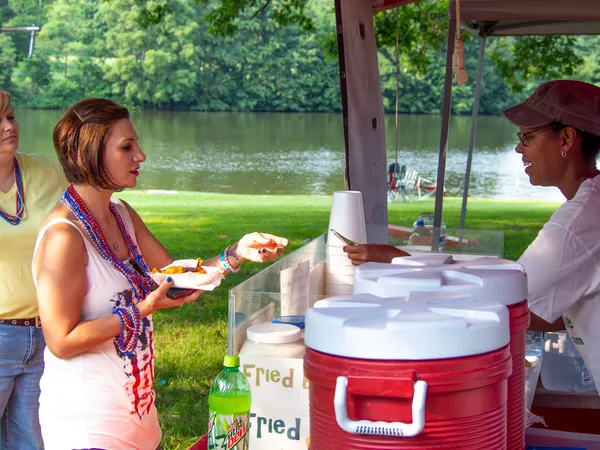
The first is the daily line — walk-up customers at a brewery, a lunch corner, or a festival. This business is impulsive, hyper-local, and driven almost entirely by one question: where is the truck today? Social media does most of the discovery work here, and operator presence skews heavily to Facebook and Instagram, with roughly 87% of trucks on Facebook and around 71% on Instagram in 2025 industry data. The daily line lives and dies on discovery.
The second business is catering and private events — weddings, corporate lunches, festivals, and brand activations. This is planned weeks ahead, booked by email or a quote form, and worth multiples of a single order. It behaves like a sales pipeline, not an impulse buy.
The economics diverge sharply. Curate's 2025 Catering Industry Report found catering now accounts for about 11% of total foodservice revenue, with over half of corporate buyers planning to increase budgets and 80% ordering at least monthly. Operators consistently report far healthier margins on catering than on basic stops. The takeaway: your daily line keeps the lights on; your catering calendar is where the profit hides. A real 2026 system feeds both — but it doesn't pretend one playbook serves both. The rest of this guide breaks down each engine, then shows how to wire them together so attention you've already earned doesn't leak away.
Engine one: the discovery layer that fills the daily line
Daily-line marketing is a discovery problem, and in 2026 it runs on three surfaces working in lockstep: social, a live schedule, and your Google Business Profile.
Social is where intent starts but not where it should end. The job of Instagram, TikTok, and Facebook is to remind followers you exist this week and push them somewhere they can act. Posting a location in a Story that vanishes in 24 hours is the single most common leak — the person who follows you Monday may not open the app on Thursday when you're parked two blocks from their office. Short video drives reach fast, but reach without a destination is wasted.
That destination is a live where-are-we-today schedule on your own site. Most trucks still don't run one cleanly — locations live scattered across Stories that expire — so an always-current schedule page is a genuine edge in most markets. It becomes the link in every bio, every post, and every Google listing: one source of truth instead of a scavenger hunt across five Stories.
The third surface is your Google Business Profile. When someone searches "food trucks near me" or your cuisine plus your city, the map pack decides who gets the walk-up. Photos, current hours, your schedule link, and a steady flow of recent reviews are what move you up. None of these three is optional, and none works alone: social creates the audience, the schedule converts curiosity into a visit, and the profile captures the local searcher who's never heard of you. Run them as one loop and the slow Tuesday becomes the exception, not the rule.
Engine two: the catering funnel where the real money is
Catering is not won by posting more. It's won by treating event inquiries like the high-value sales leads they are — and most trucks don't, which is exactly why the opportunity is open. Curate found that 57% of caterers report struggling to grow catering sales even as corporate demand rises. The constraint isn't demand. It's the funnel.
A working catering funnel has four stages, and a leak at any one of them costs you a booked date. Stage one is a real catering page — not a buried email address — that states what you cater, capacity, service area, and rough pricing logic, so the planner can self-qualify before they ever contact you. Stage two is an inquiry form that captures event date, headcount, location, and budget in the first touch, so you can respond with a relevant quote instead of a back-and-forth that gives a competitor time to win.
Stage three is speed. Event planners are comparison-shopping, and the truck that replies first and clearest usually books. An unanswered DM or a form that lands in a spam folder is a lost wedding. Stage four is follow-up: most inquiries don't book on first contact, so a short, automated nurture sequence — a quote, a reminder, a gentle check-in — recovers dates that would otherwise slip away.
The reason to build this as a deliberate funnel rather than "check the inbox when I can" is the math. A single corporate or wedding booking is worth many lunch shifts, and these buyers order repeatedly — 80% of corporate catering buyers order at least monthly. Win one well-run office account and you've created recurring revenue no amount of festival foot traffic replaces.
Where paid search fits — and where it doesn't
Google Ads earns its place in a food truck system, but only for the right job. Paid search is a high-intent capture tool, and for a mobile business that means pointing it almost entirely at catering and event bookings — not the daily line.
Here's the logic. Bidding on "food trucks near me" for walk-up lunch is usually a poor trade: the searcher is impulsive, low-ticket, and may be searching from across town where you aren't parked. You'll pay for clicks that can't convert because you're not there. Organic discovery — social, your schedule, your Google profile — handles the daily line far more efficiently.
Catering searches are the opposite. "Food truck catering near me," "hire a food truck for a wedding," and "mobile catering [your city]" are typed by someone with a date, a headcount, and a budget. That click can be worth a four-figure booking, which changes the entire cost-per-click calculation. One booked event can pay for weeks of ad spend. This is where paid search compounds.
The non-negotiable is that catering ads must land on the catering page from the funnel above — never your homepage. An ad that promises wedding catering and dumps the planner on a generic menu page burns money. Every campaign should be tracked to the inquiry, not just the click, so you know which keywords actually produce booked dates versus tire-kickers. Paid search without conversion tracking on a food truck is guessing with a credit card. Used precisely — catering-focused, landing on a purpose-built page, measured to the booking — it's one of the few channels that can scale your most profitable revenue on demand.
The metrics that actually tell you what's working
Likes and follower counts are the metrics trucks track because they're easy to see, and they're close to useless for deciding where to spend your next dollar or hour. A real system watches a different set, split by the two engines.
For the daily line, the number that matters is schedule-page traffic relative to actual turnout — and whether your busiest shifts trace back to a specific post, location, or partner. If you can't see which Friday brewery night came from which channel, you're flying blind on where to repeat. Track schedule visits, profile views and "get directions" taps on Google, and the link clicks from social. Those are leading indicators of a line.
For catering, track the pipeline like a sales team would: number of inquiries, your response time, the percentage of inquiries that convert to booked dates, and average booking value. Response time is the one most trucks ignore and the one that moves bookings most. If inquiries come in but conversion is low, your problem is follow-up or pricing, not lead volume — and that's a fixable diagnosis you can only make if you're measuring it.
Underneath both sits attribution: tying each customer and each booking back to the source that produced it. The point isn't a prettier dashboard. It's the ability to cut the festival that drains a Saturday for no return and double down on the channel that quietly fills your calendar. At SearchPod we wire every channel into one view for exactly this reason — so the decision about where to spend next is made from evidence, not vibes. Without attribution, you'll keep funding the loudest activity instead of the most profitable one.
Building the system around seasonality and local rules
A food truck's calendar isn't flat, and in Canada it's anything but. The system has to flex around a short, intense outdoor season and a regulatory layer that shapes where and when you can even park.
Seasonality is the planning backbone. In most Canadian markets, the patio-and-festival window is compressed into a handful of warm months, which means your peak demand and your peak catering inquiries arrive in a narrow band. The marketing implication is timing: catering for summer weddings and corporate events is booked months ahead, so your catering funnel and ad spend should ramp in late winter and early spring, not in July when the dates are already gone. The off-season is for filling your email list, locking in indoor private events, and nurturing the relationships that convert when the weather turns.
Local rules add another constraint worth designing around. Toronto, for example, requires a Motorized Refreshment Vehicle owner licence plus a mobile food vending permit and $2 million in commercial general liability insurance, restricts vending to designated zones for time-limited blocks, and keeps trucks at least 30 metres from an open and operating restaurant — rules the city has been actively revising. Mississauga, meanwhile, loosened its park and on-street vending rules under a pilot that began May 1, 2025. These vary city to city and change year to year, but the marketing lesson is constant: your schedule and service-area messaging must reflect where you can legally operate, and your catering page should make your real coverage area obvious so you're not fielding inquiries for events you can't serve. A system built on the calendar and the bylaws beats a louder one that ignores both.
Wiring it into one system instead of five disconnected efforts
The reason most of this fails in practice isn't any single channel — it's that the channels are run as separate, disconnected efforts that don't hand off to each other. The win in 2026 comes from the connections, not the parts.
Picture the loop running properly. A TikTok of your line at a brewery drives a spike of profile visits. Those visitors land on a schedule page that also surfaces your catering page, so a few of the office workers in that line realize you could cater their team lunch. Their inquiry hits a form that captures the date and triggers an instant reply plus a follow-up sequence. The booking gets attributed back to that one video, so you know to make more of them. After the event, an automated request turns the happy client into a Google review, which lifts your map-pack ranking, which feeds the next walk-up searcher into the top of the loop. Every piece makes the next piece work harder.
Now picture it disconnected, which is the norm: social run by one person, a website nobody updates, catering emails answered between shifts, no tracking anywhere. The same effort produces a fraction of the result because nothing compounds.
This is the case for one connected system over five vendors who don't talk to each other — a custom site and schedule, Google Ads, local SEO and your Google Business Profile, email follow-up, and review generation, all feeding one another and measured in one place. You don't need every channel maxed out on day one; you need them built to connect, so each booking and each busy shift makes the next one cheaper to earn. Whoever runs it, demand a system, not a pile of tactics. That's what separates the trucks that grow from the ones that stay stuck in feast-or-famine.