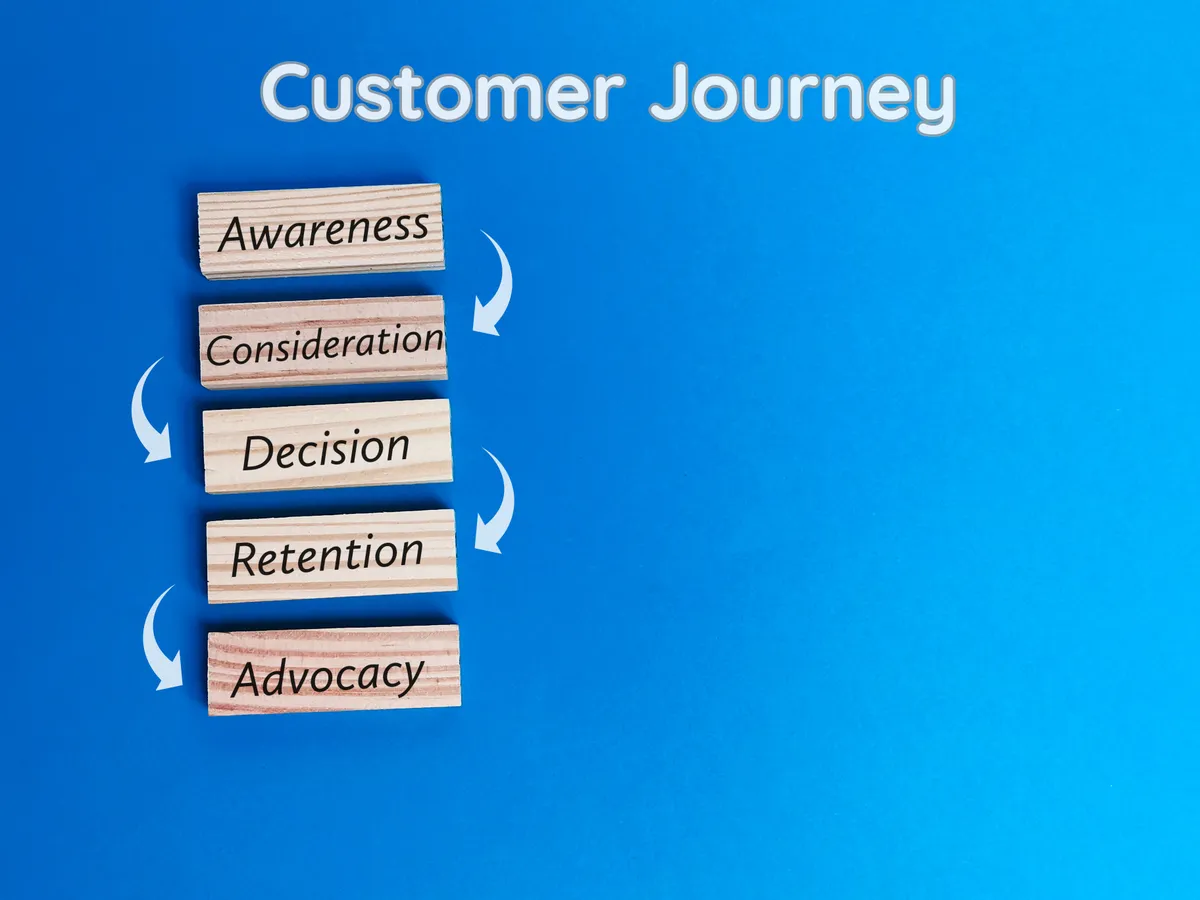
First-touch, last-touch, linear, data-driven, and custom models. When each makes sense and how to implement them.
The Question Attribution Tries to Answer
A customer books a call with you today. Three weeks ago they clicked one of your Google Ads. Two weeks ago they read a blog post they found through organic search. Last week a friend sent them your site in a text message. Yesterday they searched your brand name and clicked the top result. Which channel gets credit for the sale?
That is the attribution problem, and every attribution model is just a different rule for answering it. The rule you pick is not a technicality — it decides which channels look like winners in your reports, and therefore where next quarter’s budget goes. Run the same month of data through two different models and paid search might look like your best channel in one and a money pit in the other. Nothing about reality changed; only the accounting did.
This matters more than most measurement debates because attribution errors compound. If your model systematically over-credits the last click, you keep funding the channels that close and slowly starve the channels that introduce — until one day the top of the funnel runs dry and nobody can explain why the “efficient” channels stopped producing. The reverse error wastes money on awareness activity that never actually leads anywhere.
The honest framing for this article is this: there is no correct attribution model. There are models with different biases, a privacy environment that hides a growing share of the customer journey from all of them, and a practical question of how much measurement sophistication your business size actually justifies. We’ll take those in order — the models, what GA4 did to them, the limits, and what to actually do.
Single-Touch Models: First Click and Last Click
Single-touch models hand all the credit to one interaction. They are simple, decisive, and wrong in predictable directions — which, as we’ll see, can make them genuinely useful.
Last-touch (or last-click) attribution credits the final interaction before conversion. It is the default instinct of nearly every analytics tool in history and most people’s mental model of marketing: whatever they clicked last “drove” the sale. Its bias is systematic. Last click over-credits channels that sit at the bottom of the funnel — branded search, retargeting, direct visits — because those are where journeys end, not where they begin. Branded search in particular is a chronic credit thief: someone who saw your ad, read your content, and finally Googled your company name converted because of everything that happened before the search, but last click hands the trophy to the search.
First-touch attribution is the mirror image: all credit to the interaction that started the journey. Its champions are demand-generation people who, fairly, point out that nothing downstream happens without the introduction. Its bias is equally systematic — it over-credits awareness channels and assumes the first touch did the persuading, when in many journeys the first touch was a half-remembered impression and the real work happened later.
Where single-touch models earn their keep is in the questions they answer cleanly. Last click answers “what closes our customers?” First click answers “what introduces us to strangers?” Both are legitimate questions. The trouble starts when either one is treated as the answer to the question stakeholders are actually asking, which is “what caused the revenue?” — a question no single-touch model can answer for any journey longer than one step.
The Rule-Based Multi-Touch Models: Linear, Time-Decay, Position-Based
Multi-touch models split the credit across the journey, and the rule-based versions split it according to a fixed formula a human chose in advance.
Linear attribution divides credit equally among every touchpoint. Four interactions, twenty-five percent each. It is the diplomatic model — nobody’s channel gets zero — and that diplomacy is also its weakness. Linear asserts that a glancing display impression and the demo request that followed it contributed equally, which nobody believes. In practice, linear is less an analytical tool than a political compromise, useful mainly for demonstrating to a last-click believer that other channels were present in the journey at all.
Time-decay attribution gives more credit to touchpoints closer to the conversion, with credit typically decaying on a half-life — an interaction a week before conversion is worth a fraction of one the day before. The embedded assumption is that recent touches are more causally important, which suits long, considered purchases where late-stage interactions reflect real intent. Its bias is a gentler version of last click’s: it still structurally under-rewards the channels that start journeys.
Position-based attribution (often called U-shaped) gives large fixed shares to the first and last interactions — commonly forty percent each — and spreads the remainder across the middle. The theory is tidy: introductions and closes are the moments that matter most, and the middle is supporting cast. The arbitrariness is also tidy: why forty percent? Why should every journey, in every industry, follow the same shape?
That question — why should a human-chosen formula apply uniformly to every journey? — is the critique that data-driven attribution was built to answer, and it is why the rule-based models’ days were numbered.
Data-Driven Attribution: Credit by Algorithm
Data-driven attribution abandons fixed formulas entirely. Instead of a human deciding that the first touch deserves forty percent, an algorithm examines large volumes of converting and non-converting paths and estimates each touchpoint’s actual contribution to the probability of conversion.
The core idea is counterfactual. The model compares journeys that included a given touchpoint against similar journeys that didn’t, and asks: how much did the presence of this interaction change the likelihood that the journey ended in a conversion? Touchpoints that reliably appear in converting paths — and whose absence correlates with non-conversion — earn more credit. Google’s implementation incorporates signals like ad format, time between touch and conversion, and device, so the same channel can earn different credit in different contexts. In principle, this is exactly what you want: credit assigned by evidence rather than by committee.
In practice, data-driven attribution has two costs worth understanding. The first is data hunger. The model needs enough conversion volume to find patterns; below that, its estimates are noisy, and for genuinely small accounts there may not be enough signal to outperform a simple rule. The second is opacity. Rule-based models are wrong in ways you can see and reason about. A data-driven model is a black box: when it shifts credit between channels, you cannot inspect why, you cannot audit the math, and you are trusting the vendor — usually the same vendor selling you the ad inventory being graded — to referee fairly. That conflict of interest doesn’t make the model wrong, but it is a reason to keep an independent check on its conclusions rather than accepting them as ground truth.
With those caveats stated, data-driven attribution is the best general-purpose model available for accounts with real volume — which is presumably why Google stopped offering you the alternatives.
What GA4 Did: Data-Driven by Default, Manual Models Retired
If you’re measuring in Google’s ecosystem, much of the model-selection debate has been settled for you. In 2023, Google deprecated the rule-based attribution models — first click, linear, time-decay, and position-based — in both GA4 and Google Ads, removing them first for new properties and then retiring them entirely later that year. What remains in GA4 is data-driven attribution, which is the default, and last-click options: a paid-and-organic last click model, plus a variant that prefers Google paid channels for advertisers who want to evaluate their ads that way.
Google’s stated reasoning was low adoption of the manual models and the superiority of the data-driven approach. The cynical reading is that a model only Google can compute, grading channels Google sells, became the only sophisticated option. Both readings can be true at once. Either way, the practical reality for most businesses is that GA4’s attributed conversion numbers are data-driven numbers, and month-over-month shifts in channel credit can reflect the model recalculating, not just your marketing changing.
A few GA4 specifics worth knowing. The attribution model is set at the property level and applies to the traffic-acquisition dimensions in standard reports; you can change it in the property’s attribution settings, and the change applies retroactively to how historical conversions are displayed. Conversion windows are configurable there too. The Advertising section’s model comparison report lets you view the same conversions under data-driven and last-click lenses side by side — and that comparison is quietly one of the most useful reports in GA4, because the gap between the two models is a direct measurement of how much your bottom-of-funnel channels are borrowing credit from everything upstream.
One more distinction that trips people up: GA4’s user-acquisition reports answer a first-touch-style question — which channel first brought this user — while session and event-scoped reports follow your selected model. Different reports in the same tool answering different attribution questions is not a bug, but you do have to know which question each report is answering.
The Privacy Problem: Every Model Is Working From Partial Data
Here is the part the model-comparison articles tend to skip: every attribution model, including the data-driven one, can only assign credit to the touchpoints it can see. And the share of the journey that measurement tools can see has been shrinking for years.
The causes stack on top of each other. Apple’s App Tracking Transparency framework made cross-app tracking opt-in, and most users decline. Safari and Firefox aggressively limit cookies, truncating the window in which a returning visitor can be recognized as the same person. Consent banners mean a meaningful slice of visitors are never tracked at all, with the analytics record simply missing their journeys — or, where consent-mode-style approaches are used, replaced by statistical modeling. Ad blockers take a further cut. People browse across devices — research on a work laptop, convert on a personal phone — and look like two strangers. And a large share of real-world influence flows through channels that have never been trackable: links shared in group chats and DMs, podcast mentions, word of mouth, all arriving in your analytics as “direct” traffic with no history.
The platforms’ answer to these gaps is modeled conversions — machine-learned estimates of the conversions they can no longer observe, blended into reported totals. Modeling is a reasonable response to missing data, but understand what it means: a growing portion of your attribution reporting is an estimate of an estimate, produced by the party being graded.
The conclusion to draw is not that attribution is useless. It’s that attribution data is a sample, not a census — biased toward consenting, single-device, cookie-accepting Chrome users — and that treating any attributed number as exact, down to the lead, is a category error. The number is evidence. It was never the whole truth, and it is less of the truth every year.
What to Actually Use, by Business Size
Attribution sophistication should be proportional to spend, conversion volume, and channel count. Most businesses get this backwards — small companies agonizing over multi-touch nuance, large ones still running on last click out of habit.
If you’re a local or small business — a handful of channels, modest ad spend, conversions counted in the dozens per month — elaborate attribution is solving a problem you don’t have. Your journeys are short, your channel mix is small, and your conversion volume is too thin for algorithmic models to learn much from. Use GA4’s defaults, tag every campaign link with UTMs, and put a “how did you hear about us?” field on your forms — for phone-call and walk-in businesses, that one question routinely outperforms the entire analytics stack. Your job is directional: know roughly which two or three things produce customers, and don’t cut any of them based on a model’s decimal points.
Mid-sized businesses running several channels with real budget are where attribution starts paying rent. Keep data-driven attribution as the lens, but use GA4’s model comparison against last click to understand each channel’s role — introducer, assister, or closer — and judge channels by role, not by a single attributed number. Add call tracking if the phone matters, push conversions into the ad platforms via enhanced or offline conversion uploads so the algorithms optimize toward real outcomes, and reconcile attributed conversions against your CRM monthly, because the CRM counts revenue and analytics counts events.
Larger advertisers — many channels, long sales cycles, six-figure-plus annual spend — should stop expecting any touchpoint model to settle budget questions and add the techniques that don’t depend on tracking individuals: media mix modeling, which infers channel contribution from spend and outcome data statistically, and incrementality testing — geo holdouts, on-off experiments — which measures what happens when a channel is actually removed. Experiments are the only attribution method that demonstrates causation rather than assigning credit. At that scale, attribution models become the day-to-day instrument panel, and experiments become the audit.
Perfect Attribution Is a Fantasy. Directional Truth Is Enough.
The dirty secret of attribution is that the platonic version — every dollar of revenue traced precisely to the marketing touches that caused it — has never existed and never will. Even before the privacy era, no model could see the conversation where a friend said “just use these guys,” and no algorithm can untangle true causation from a web of correlated touchpoints. The privacy era didn’t break perfect attribution; it broke the illusion that we were close to it.
What’s actually achievable is directional truth: confident answers to the questions that drive decisions. Which channels would hurt us if we cut them? Is this new channel producing anything at all? Is the blended cost of acquiring a customer rising or falling? Are our bottom-funnel numbers flattering channels that merely harvest demand other channels created? Attribution data — imperfect, sampled, modeled — answers these questions perfectly well, as long as you read it for direction and magnitude rather than false precision.
The working method is triangulation. Let data-driven attribution be the default lens. Check it against last click to see who’s borrowing credit from whom. Check both against self-reported attribution from forms and sales calls, which catches the dark-funnel journeys analytics never sees. Check everything against the CRM and the bank account, because blended revenue against blended spend is the one number no model can spin. When all the instruments roughly agree, act with confidence. When they disagree sharply, that disagreement is itself the finding — go investigate it.
And one closing test for any attribution effort: it should change decisions. If a more sophisticated model wouldn’t move a single dollar of your budget, you don’t need it yet. If you’re making six-figure channel decisions on last click alone, you needed a better lens last year. Attribution is not a search for the true number. It’s a set of instruments for steering — and instruments only need to be accurate enough to keep you off the rocks.