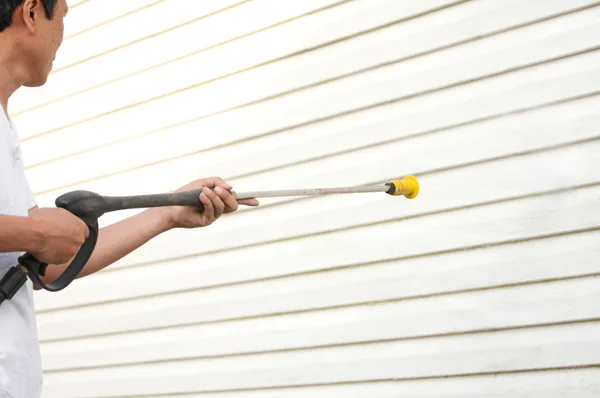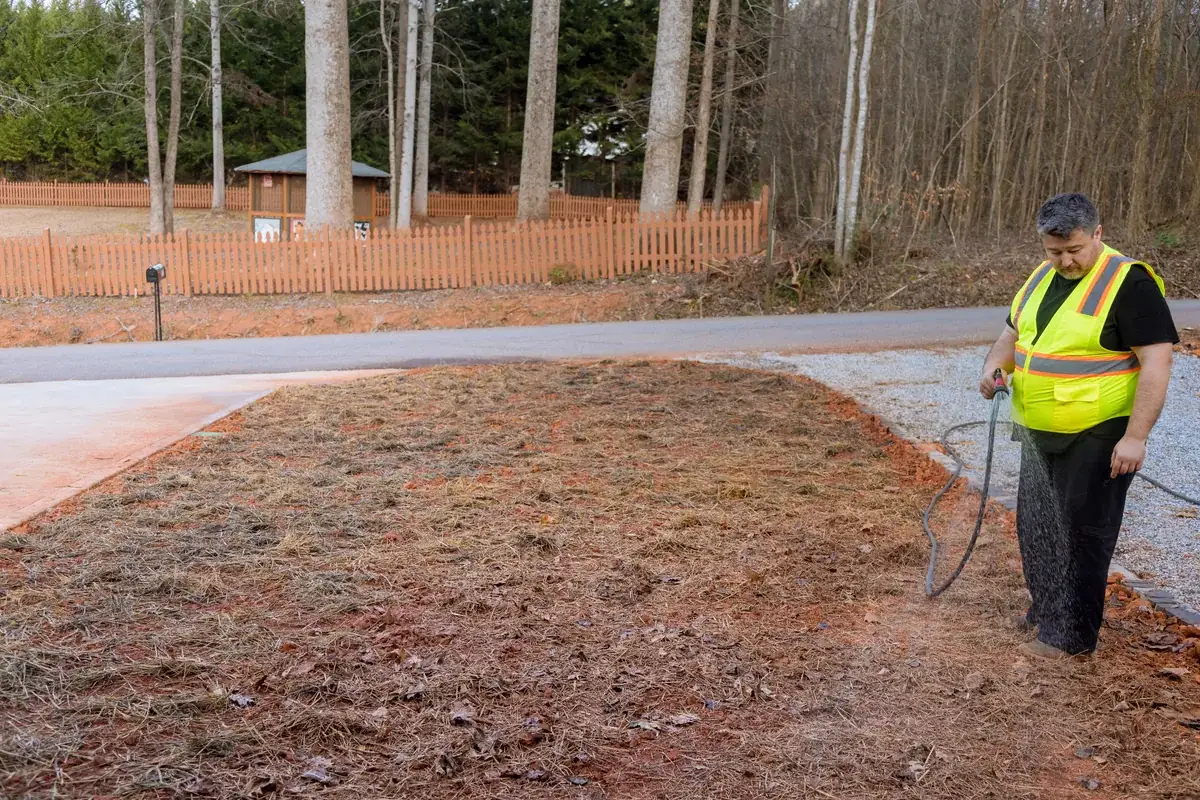
How pressure washing companies win jobs in 2026: the channels, the funnel, and the economics that turn one wash into recurring revenue.
Start with how a pressure washing customer actually decides
Before you touch a single channel, get clear on the buying decision you're trying to win, because it shapes everything downstream. Pressure washing is a high-intent, fast-decision purchase. A homeowner notices the green creep on their siding, the black streaks on the roof, or the gray cast on the driveway, and within a day or two they search, look at a couple of companies, and book. There's almost no consideration phase the way there is with a kitchen remodel. The job is won or lost in the first few minutes of attention.
Three things settle it: proximity, proof, and friction. Proximity, because a homeowner wants someone local who can come this week. Proof, because exterior cleaning sells on the visible result — before/after photos and a wall of recent five-star reviews do more convincing than any sales copy. Friction, because the company that makes it easiest to get a number and a date usually wins, even over a slightly cheaper competitor who's harder to reach.
That's the whole game in miniature. Your marketing system isn't trying to educate or nurture a skeptical buyer over months. It's trying to be the first credible, local, easy-to-book option the moment intent appears — and then to bring that customer back next season instead of paying to acquire them all over again. Every channel below is a different way to either show up at the moment of intent, remove friction from the booking, or reactivate a past customer. Hold that frame and the system stops looking like a pile of disconnected tactics.
The five channels that win the job — and the order they fire
A working 2026 pressure washing system runs five channels, and they fire in a deliberate sequence rather than as separate campaigns. Think of it as four ways to get found plus one way to get re-booked.
Local Services Ads sit at the very top. For exterior cleaning, Google groups pressure washing, window cleaning, and gutter cleaning under a single "Window Cleaning" LSA vertical — you switch on the specific job types inside that one profile — and these pay-per-lead units appear above both search ads and the map pack. They carry the Google Verified badge, the consolidated trust check that replaced Google Guaranteed and Google Screened in October 2025, which requires passing background, license, and insurance checks and keeping them current. You pay per lead, not per click, so the discipline here is making sure those leads actually become booked jobs rather than just inbox noise.
Google Search Ads come next — standard PPC for terms like "house washing near me" and "driveway cleaning [city]," routed to a dedicated landing page rather than your homepage.
The map pack (local SEO) is the unpaid version of the same intent, and it's where you stop renting clicks and start owning them. AI search is the newest layer: when someone asks ChatGPT, Gemini, or Google's AI Overviews to recommend a pressure washer, your reviews and structured site content decide whether you get named.
Fifth is email and review automation — the engine that turns the jobs the first four channels produced into repeat revenue. Paid buys you speed; organic and AI build durability; the fifth channel is where the profit actually compounds.
The funnel: search, quote, booked, re-clean
Map your system to four concrete stages, because that's how you find the leak that's costing you jobs. The pressure washing funnel is short and physical: a high-intent search, a quote request, a booked job, and a re-clean. Each stage has its own failure mode, and most companies are quietly losing money at one specific point without knowing which.
Stage one, search, is a visibility problem. If you're not in the LSA unit, the map pack, or the AI answer for your services and neighborhoods, you never enter the race. Stage two, quote, is a friction and speed problem. A homeowner who fills a form or calls expects a fast response — and most still call before they book, so an unanswered phone or a quote that takes a day is a job handed to the competitor down the street. An automatic text-back on missed calls is one of the highest-ROI fixes in this trade.
Stage three, booked, is a conversion problem. Does your site make it obvious what you clean, show real before/afters, prove you're insured, and let someone request a date in a couple of taps? Or does it bury the phone number under a stock photo?
Stage four, re-clean, is the one almost everyone ignores — and it's where the economics live. A house typically needs washing once or twice a year, so a customer you won this spring is a known, warm buyer next spring. The system's job is to bring them back automatically instead of letting them re-Google and possibly hire someone else. Diagnose which of the four stages is leaking, and you'll usually find the cheapest growth you have.
The numbers that actually run the business
Run this trade on three numbers, not on "are we getting leads." Lead volume is vanity; these are the metrics that tell you whether the system is profitable and where to push.
First, cost per booked job — not cost per lead, not cost per click. A lead that never books costs you the same as one that does, so you have to tie spend all the way through to a job on the calendar. The math is simple but unforgiving: take what a channel costs you, divide by the share of its leads that actually book, and you get your true acquisition cost. A channel that looks cheap per lead can be expensive per job if half the leads ghost you — and a channel that looks pricey per lead can be your best one if it closes. The only way to know is to track it. Then weigh that number against your average ticket, which you already know from your own invoices far more accurately than any published benchmark.
Second, lifetime value, not first-job value. The reason a higher acquisition cost can still be fine is that a happy customer re-cleans, refers neighbors, and — if you offer it — takes a maintenance plan. Converting one-time cleans into recurring relationships is the single biggest lever for steadying cash flow. The catch: if those recurring customers churn quickly, the lifetime-value math collapses, so retention is a metric you watch, not an afterthought.
Third, service-level ROI. House washing, driveways, roof soft-washing, and recurring commercial accounts don't earn the same margin or cost the same to acquire. Track them separately and you'll find the one or two services worth pouring budget into.
Before/afters and reviews are your conversion engine — systematize them
Treat proof as infrastructure, not content you post when you remember. In exterior cleaning, before/after photos and reviews aren't marketing garnish — they are the mechanism that converts an interested homeowner into a booked one, and they feed every channel at once. The mistake nearly every operator makes is leaving both stuck on a phone or in a customer's head.
Reviews carry outsized weight here for a structural reason. In Google's local ranking, prominence — driven heavily by the number, quality, and recency of your reviews — is one of the main forces deciding who appears in the map pack, and your Google Business Profile is where most of those signals live. Recency matters: a steady drip of fresh reviews beats a big batch from two years ago. So the system isn't "ask for reviews sometimes." It's an automated request sent at the right moment after every completed job, so the flow never stops. Those same reviews are increasingly what AI assistants read when they decide which company to name.
Before/after photos do the same double duty. On your site they answer the only question a homeowner really has — will my driveway look like that? In your ads they out-pull any headline. On your Google profile they signal activity and quality. A simple habit — one tagged before and after on every job, captured the same way each time — turns a day's work into a month's worth of conversion assets. Build the capture into the job, not into your spare time, and the proof engine runs itself.
Engineer around seasonality instead of riding it
Plan your marketing against the calendar, because seasonality is the defining economic feature of this trade and the cause of most feast-or-famine stress. Demand spikes in spring and summer and falls off through winter, especially in Canadian markets where freeze-thaw and snow shut down most exterior work for months. A system that just spends evenly all year wastes budget in the quiet months and fails to capture the rush.
The move is to use marketing to reshape the demand curve rather than passively follow it. Pull bookings forward by getting in front of homeowners early — the company that captures the spring rush is the one already ranking and advertising in late winter, before competitors wake up. Smooth the trough by leaning on the channels that don't depend on fresh strangers: email reactivation to last year's customers, re-clean reminders timed to the roughly annual cycle, and offers that fill otherwise dead weeks. And shift budget toward the services and segments that stay active longer — commercial and HOA accounts, gutter cleaning, or interior-adjacent work — when residential house washing slows.
The deeper fix for seasonality is the recurring base. A book of maintenance-plan and commercial accounts means every season doesn't start from zero. That's why the retention half of the system isn't optional decoration — it's what converts a business that panics every November into one with a predictable floor of revenue. Marketing that ignores the calendar will always feel like riding waves; marketing built around it starts to feel like a schedule you control.
Why it has to run as one connected system
The reason all of this is framed as a system, not a checklist, is that the channels only pay off when they feed each other. A pressure washing company that hires one vendor for ads, another for SEO, a third for the website, and handles reviews by hand ends up with parts that don't talk — and the gaps between them are exactly where jobs leak.
The connections are concrete. Reviews lift your map-pack rank and your AI-search visibility and your ad performance simultaneously — one input, three payoffs. Your before/after library has to live on the site, in the ads, and on the Google profile to do its full job. Conversion tracking only tells you your true cost per booked job if call tracking, form tracking, and your scheduling tool are wired into the same picture; broken into silos, every vendor claims credit and nobody can prove what actually produced a job. And the email reactivation that drives your most profitable, lowest-cost revenue depends on the booking data the front-end channels generate. Cut any thread and the whole thing underperforms.
This is the case for running the front of the funnel — website, Google Ads, SEO, AI search — and the back — email, reviews, tracking — as one coordinated operation rather than a scatter of vendors. That's the model SearchPod is built around, but the lesson holds however you assemble it: in 2026 the pressure washing companies with full calendars aren't the ones with the best single tactic. They're the ones running a connected system where speed, proof, and follow-up reinforce each other instead of working in isolation. Pick the stage that's leaking, fix it, then wire the channels together so the next job is cheaper to win than the last.