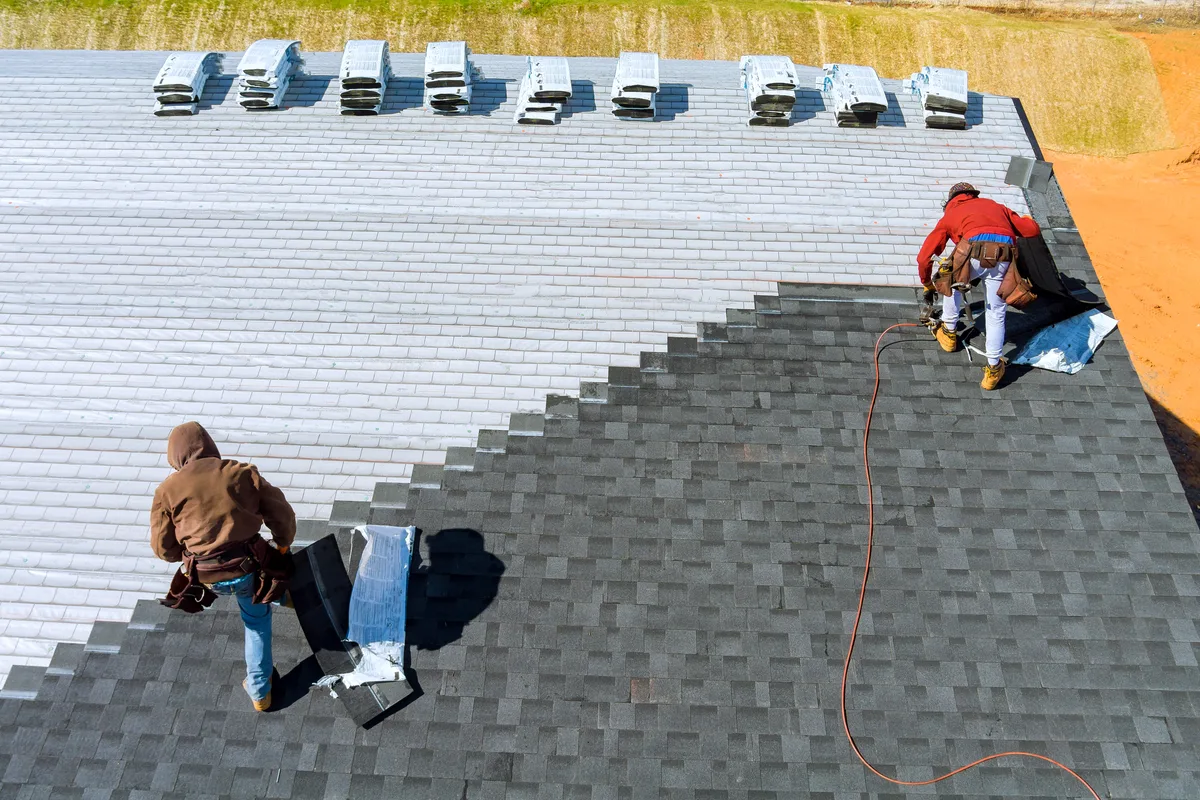
How roofing marketing actually works in 2026 — channels, funnel stages, storm-season timing, and the cost-per-booked-job math that fills a schedule.
Start with the economics, not the tactics
Before you spend a dollar on marketing, get clear on what a roofing job is actually worth — because that number decides what you can afford to pay to win one. In Canada in 2026, a typical asphalt shingle replacement runs roughly $7,500 to $18,000, and a metal roof commonly lands between $15,000 and $36,000, depending on size, pitch, city and material (ranges consistent across Homeowner.ca, RenoQuotes and several Ontario contractors). Even a repair is often a few hundred to a couple thousand dollars. These are high-ticket jobs, and that changes the whole math.
Here's why that matters. The cost per lead for roofing on Google sits somewhere between roughly $45 and $125 through Local Services Ads, and higher on traditional search ads — often well over $100, with competitive markets reporting more. At first glance $120 for a lead feels expensive. But if you close one in four or five qualified leads into a replacement, your acquisition cost is a few hundred dollars against a five-figure job. The leads aren't the problem. Bad leads, slow follow-up, and not knowing your numbers are the problem.
So the first job of a marketing system isn't to generate traffic — it's to know, per channel and per service, what it costs you to book a real job. Without that, you're guessing. With it, every later decision (spend more here, kill that, hire a second crew) becomes obvious. Set up call tracking and form tracking before you scale anything; the system is only as good as the numbers feeding it.
You're marketing to three different buyers
A roofing company isn't selling one thing — it's serving three distinct buyers, and each one searches, decides and buys differently. Treating them as one audience is the most common reason campaigns underperform.
The repair buyer has a leak or a few missing shingles. They search 'roof leak repair near me,' they want someone out this week, and they decide fast — often on the first or second call. Speed and availability win this job; the price is small enough that they're not getting five quotes.
The replacement buyer knows their roof is at end of life. This is a planned, high-consideration purchase. They search 'roof replacement cost' and 'best roofing company [city],' they read reviews carefully, they get two or three quotes, and they often need financing or want to understand the warranty. This buyer is won on trust and follow-up, not speed — the contract might be signed weeks after the first inspection.
The storm-damage buyer didn't plan anything. Hail or wind hit, and now they need an inspection and help navigating an insurance claim. They're anxious, they want a contractor who handles the claim end to end, and — critically — they tend to book the first credible roofer who actually shows up.
Your website, ads and content should speak to all three with separate paths: a dedicated repair page, a replacement page with financing and warranty cues, and a storm/insurance page. One generic 'we do roofs' message converts none of them well.
The channel stack that actually books jobs
There's no single channel that fills a roofing schedule — there's a stack, and each piece does a specific job. Run them as one system and they compound; run them in isolation and you waste money.
Local Services Ads (LSA) sit at the very top of Google and you pay per lead, not per click. For roofers they tend to convert notably better than standard search ads — published roofing benchmarks put LSA around a 31% lead-to-customer rate versus roughly 12% for traditional PPC (Baadigi). One important change to know in 2026: on October 20, 2025, Google retired the separate 'Google Guaranteed,' 'Google Screened' and 'License Verified' labels and consolidated them into a single 'Google Verified' badge, and began winding down the old consumer money-back guarantee (final reimbursement requests were accepted through December 7, 2025). You still earn the badge by passing background, license and insurance checks — get that done, because the badge is a trust signal homeowners look for.
Google Search ads (PPC) capture high-intent searches LSA doesn't, and let you send each buyer to a purpose-built landing page. Expect several dollars to $25+ per click on high-intent terms, and more during storm season. This is your fastest lever — booked inspections in the first few weeks.
Local SEO and Google Business Profile win the map pack and the clicks you don't pay for — but it compounds over months, not days (more on timing below).
Reviews and AI search are the trust layer. Reviews feed your rankings, your LSA, and increasingly the AI assistants homeowners now ask 'who's the best roofer near me.' They make every other channel convert better.
The funnel: click to signed contract
A booked job is the result of a sequence, and money leaks at every transition. Map the funnel explicitly and you can see exactly where you're losing work.
Stage one is visibility — being present when a homeowner searches. If you're not in LSA, the ads, or the map pack, the funnel never starts. Stage two is the click-to-contact conversion: does your site or ad turn an interested homeowner into a call, form, or booking? This is where most roofing websites quietly fail — slow load, no real project photos, no online scheduling, no obvious phone number on mobile.
Stage three is contact-to-inspection. Most homeowners still phone before they book, and a missed or fumbled call is a lost job worth thousands. The fix is boring but decisive: answer the phone, and when you can't, fire an automatic text-back so the homeowner hears from you in seconds instead of calling the next roofer.
Stage four — inspection-to-signed-contract — is where replacements are won or lost. The homeowner has two or three quotes on the table. The roofer who follows up wins. Automated estimate follow-ups, financing and warranty reminders, and a quick answer to questions tip the bid in your favour.
Stage five is post-job: the review request and the referral. This isn't an afterthought; it's the fuel that makes stage one cheaper next month. Track conversion at each stage and your weakest link tells you exactly what to fix next.
Storm season is won in the off-season
Storm and hail work is among the most lucrative — and most time-sensitive — demand a roofer sees, and the companies that win it prepared months early. After a major hail or wind event, contractor call volume can spike several-fold within the first 24 hours — industry reports describe surges on the order of 500% to 1,000% for the busiest shops — and stays elevated for weeks as homeowners work through inspections and claims (PinkCallers, PowerChord). The catch most owners underestimate: the contractor who reaches a homeowner first reportedly lands a large share of those jobs, and the most valuable window is roughly the first 72 hours.
You cannot build your visibility during the storm. Earning your way into the map pack takes months of consistent local SEO, not days. So the work is to have a storm-damage landing page, an LSA profile that's already verified, reviews already in place, and a Google Ads campaign you can switch on or scale the moment a system rolls through. When the storm hits, you raise budgets and respond fast — you don't start from zero.
The storm buyer also needs reassurance on insurance. A page that explains you handle the claim from inspection to final approval converts the anxious homeowner far better than a generic 'free estimate' button.
Seasonality runs deeper than storms, too. Spring accounts for a large share of annual roofing revenue — JobNimbus pegs it at roughly a third — so a smart system front-loads SEO and content in winter, scales paid spend into spring and storm season, and keeps follow-up nurtures running year-round so off-season leads don't go cold.
The metrics that actually matter
Most roofers track the wrong numbers — clicks, impressions, 'rankings' — and stay blind to the one that pays the mortgage. Here are the metrics a real system watches.
Cost per booked job, by service. Not cost per lead — cost per actual job, separated into repairs, replacements, metal, and storm work. A $120 lead that becomes a $14,000 replacement is a triumph; a $40 lead that never books is a loss. Only this number tells you where to put the next dollar.
Lead-to-booked-job rate, by channel. LSA, PPC, SEO and referrals convert at different rates. If your PPC leads book at half the rate of your LSA leads, that's either a targeting problem or a follow-up problem — and you can only see it if you're attributing every booking to its source.
Speed-to-lead. How fast does a new inquiry get a human response? Given the storm math above, minutes matter. Track it, because it's usually the cheapest thing to fix and the highest-leverage thing to improve.
Review velocity. How many new Google reviews per month, and what star average? This is a leading indicator of future rankings and AI-search visibility, not a vanity metric.
If you can answer 'what does it cost me to book a replacement from Google Ads, and is that number going up or down?' you have a marketing system. If you can't, you have a collection of expenses.
AI search is changing the first question homeowners ask
A growing share of homeowners no longer start at the Google search box — they ask an assistant. 'Who's the best roofing company near me?' 'Find a roofer in [city] that handles insurance claims and offers financing.' ChatGPT, Gemini, Google's AI Overviews and Perplexity now answer those questions with a shortlist, and being on that shortlist is becoming its own discipline — sometimes called AI search optimization or GEO.
The encouraging part for roofers: the signals that earn AI recommendations overlap heavily with what already wins local search. A complete, accurate Google Business Profile, a strong and recent review profile, clear service and location pages that state plainly what you do and where, and consistent business information across the web all feed the models. AI assistants lean on structured, trustworthy, well-reviewed sources — so the roofer with a deep, recent base of genuine five-star reviews and clear service pages tends to surface ahead of the one with a thin site and a handful of reviews.
This is not a reason to abandon Google Ads or local SEO. It's a reason to make sure the foundations — reviews, profile, clear content — are solid, because they now pay off in two places at once. The practical move for 2026 is to treat your review engine and your service pages as feeding both classic search and AI recommendations, rather than building separately for each. The homeowner asking an AI for a roofer is high-intent and ready; you want to be the name it returns.
Putting the system together
A roofing marketing system isn't six tools bolted together — it's six channels pointed at one calendar and measured by one number. The order of operations matters more than most owners expect.
Start with the asset you own: a fast, trust-building website with real project photos, separate paths for repair, replacement and storm work, financing and warranty cues, and online scheduling. Everything else drives traffic to this, so it has to convert. Then layer paid — LSA and Search ads — for jobs now, and turn on tracking the same day so you learn your true cost per booked job from week one. In parallel, begin the slow-compounding work: local SEO, Google Business Profile, and a review engine that asks every happy customer at the right moment. Wire in follow-up — missed-call text-back, estimate nurtures, past-customer campaigns — so no hard-won lead dies in an inbox.
The reason to run this as one connected system rather than five separate vendors is simple: the parts feed each other. Reviews lift your ads and your SEO and your AI visibility. Ads buy you data that makes your SEO smarter. Follow-up rescues the leads every channel produces. When they're disconnected, you pay for all of it and capture a fraction.
That's the approach we take at SearchPod — one team running the website, ads, SEO, AI search, email and reviews together, with client-owned accounts and tracking that ties every booked job back to its source. However you build it, the principle holds: know your numbers, serve all three buyers, prepare for storm season before it arrives, and treat the whole thing as one machine, not a pile of tactics.