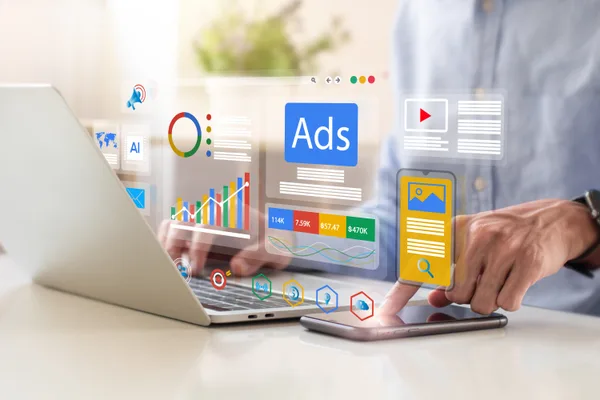
The allocation framework for splitting budget between paid promotion and organic content creation.
Paid vs Organic Is the Wrong Fight
Every quarter, somewhere in a marketing meeting, the same argument plays out. One side says organic social is dead — reach has collapsed, nobody sees the posts, just run ads. The other side says ads are a treadmill — the moment you stop paying, everything stops, so build an audience you own. Both sides are armed with a real observation and a wrong conclusion.
The wrong conclusion is that paid and organic compete for the same job. They don’t. Paid social buys reach: you specify who sees the message, and the platform delivers them, at a price, for as long as you keep paying. Organic social builds evidence: a living, public record that your business is active, competent, and liked, which mostly gets consumed by people who were already on their way to you. One is a demand engine; the other is a trust asset. Asking which is better is like asking whether a delivery van is better than a storefront.
The budget question, then, isn’t which one wins. It’s how much of your money and time each job deserves right now, given your stage, your sales cycle, and what’s actually broken in your funnel. A business nobody has heard of has a reach problem — that’s a paid job. A business getting clicks that don’t convert into inquiries often has a trust problem — and a dead Instagram grid from eight months ago is quietly contributing to it.
This article is the allocation framework we use to split budget between the two: what each side genuinely does, the signals that tell you which job is underfunded, and the splits that make sense at different stages.
What Organic Social Actually Does in 2026
Start with an honest accounting of organic, because most disappointment with it comes from assigning it a job it stopped doing years ago.
The job it stopped doing is free distribution. On Facebook and Instagram, the share of your own followers who see a typical business page post organically has been low for years — single-digit percentages are the commonly cited norm, and for most local businesses the practical reality is that a feed post reaches a small fraction of an already small following. Posting more doesn’t fix this; the algorithm isn’t withholding your content out of spite, it’s ranking it against everything else competing for the same scroll, and a business update rarely wins that auction. If your growth plan is “post consistently and the audience will come,” you are planning around a mechanic that no longer exists for most accounts.
What organic still does — and does irreplaceably — is validation. When a prospect hears about you from an ad, a referral, or a Google search, a meaningful share of them will look you up on social before contacting you. What they find functions exactly like a storefront window: a profile with recent work, real photos, answered comments, and consistent activity reads as a healthy business. A grid that went silent last spring reads as a business that might not pick up the phone. You will almost never see this effect in a dashboard, because the platforms attribute nothing to it — but it shows up as the gap between people who consider you and people who contact you.
Organic has two other durable jobs: it’s where existing customers stay warm between purchases, and — critically for the paid side — it’s your content laboratory. Every organic post is a free test of a message, an offer, or a piece of creative. The handful that outperform are telling you, with real audience behavior, what deserves money behind it.
The exception to the reach pessimism is short-form video. Reels and TikTok still distribute content to non-followers based on engagement rather than follower count, which means organic video can genuinely reach new people. It’s the one organic format where distribution is still earnable — at the cost of real production effort and a hit rate that’s honestly unpredictable.
What Paid Social Actually Does — and Where It’s Weak
Paid social’s pitch is simple: it removes the reach problem entirely. You define an audience by geography, age, interest, or behavior — or hand the platform a conversion goal and let it find buyers — and your message appears in front of people who have never heard of you, starting tomorrow. For a new business, a new offer, or a seasonal window, nothing organic can match that speed.
Its second strength is measurability. Paid campaigns produce numbers you can manage against — cost per click, cost per lead, return on ad spend — which makes paid the only side of this equation you can scale deliberately. When a campaign produces leads at an acceptable cost, you can buy more of them. Organic never gives you that lever; you can’t reliably purchase a second viral Reel.
Now the weaknesses, because they shape the allocation. First, paid social is rented attention with no residue. The day the budget stops, the impressions stop, and unlike SEO or an email list, nothing compounds — every month starts at zero. Second, social ads are interruption, not capture. Unlike search ads, where the user has declared intent by typing a query, social ads reach people who were doing something else. That makes them excellent for demand creation — putting a kitchen renovation in front of someone who wasn’t searching for one — and structurally worse at harvesting urgent, high-intent demand, which is why emergency and need-it-now services usually find search a better first dollar than social.
Third, and least appreciated: paid social leans on the very trust assets organic builds. Users check the profile behind an ad. Meta’s formats pull your page imagery, your follower activity, and the comments under the ad itself into the impression. An ad from a hollow, inactive page converts worse than the same ad from a visibly alive one — which is the first concrete reason this is an allocation question rather than an either-or.
When to Put Money Behind It: The Case for Paid
With the jobs defined, the decision criteria get much cleaner. Paid is the right place for the next dollar when one of these conditions holds.
You need volume on a deadline. A launch, a seasonal window, a new location, a slow month that needs filling. Organic cannot be summoned on a schedule; paid can. If the business problem has a date attached, it’s a paid problem.
Nobody knows you exist. Early-stage businesses often spend months perfecting an organic presence that nobody visits, like staging a beautiful shop on a street with no foot traffic. If your following is small and your local awareness is low, organic effort has almost no audience to compound against — paid distribution is what puts the first real audience in front of the storefront.
An organic post has already proven itself. This is the highest-confidence paid spend available to most small businesses: a post that organically outperformed its siblings — more saves, shares, comments, DMs — has been pre-tested by real audience behavior. Amplifying proven winners consistently beats producing creative straight into the ads manager, because the riskiest variable, the creative itself, has already cleared a bar.
You have an offer with a measurable response. Paid spend is easiest to justify when there’s a conversion to count — a booking, a quote request, a sale. If you can state what a lead is worth, you can manage paid spend like an investment instead of a hope.
You’ve built audiences worth retargeting. Website visitors, video viewers, engagers, customer lists — warm audiences typically convert at meaningfully better rates than cold ones, and they only exist if something (often organic content and prior traffic) fed them. Retargeting is where paid and organic visibly cooperate: organic fills the pool, paid converts it.
When to Invest in Organic: The Case for Building
Organic deserves the next unit of budget — which for organic usually means time and production effort rather than ad spend — under a different set of conditions.
Your paid traffic isn’t converting into contact. If ads are delivering clicks and profile visits but inquiries are thin, the leak is often downstream of the ad: a sparse profile, no recent proof of work, unanswered comments. Before raising the ad budget, fix what people find when they check you out. This is the cheapest conversion-rate improvement most local businesses have available.
Your sales cycle is long or considered. Renovations, legal services, B2B, anything where buyers research for weeks — these businesses are evaluated repeatedly before contact, and a consistent organic presence does silent work at every evaluation. Short-cycle impulse purchases lean paid; long-cycle considered purchases justify a heavier organic weighting.
Your business is visual or local. Trades, restaurants, fitness, design, events — work that photographs well earns organic attention at a discount, and local audiences are small enough that consistent presence plus tagging, geotags, and community interaction can achieve real share of attention without spend. A B2B software company has a much weaker organic case on Instagram and a much stronger one on LinkedIn, where individual expertise posts still earn unpaid reach.
You have no proof shelf. Reviews, before-and-afters, customer stories, your face and your team — if a stranger scrolling your profile for thirty seconds wouldn’t trust you with a deposit, organic is underfunded no matter what the reach numbers say.
One discipline keeps organic investment honest: cap it. Organic effort expands to fill whatever time you allow it, and consistency beats volume everywhere on social. Three solid posts a week sustained for a year outperforms a heroic daily schedule that collapses in March. Decide the sustainable cadence first, then size the effort to it — not the other way around.
The Allocation Framework: Splits by Stage
Here’s the framework, stated plainly and then qualified. Count organic honestly — the hours, the photography, the editing, the management fee — as budget, because it is. A “free” channel that consumes fifteen hours a week is not free.
New or unknown business, first 6–12 months: weight heavily toward paid — as a typical starting point, think 70–80% of social budget on distribution, 20–30% on a deliberately minimal organic baseline. The baseline’s job is to make the profile look alive when ad-driven visitors check it: a complete profile, a proof shelf of best work, and a sustainable posting cadence. The mistake to avoid at this stage is inverting the split — months of careful content production for an audience of two hundred people.
Established business with steady demand: this is where the balance typically moves toward 50/50, or 60/40 in whichever direction your diagnostics point. Paid sustains lead flow and amplifies proven posts; organic compounds the trust asset, feeds retargeting pools, and keeps customers warm. The weekly decision becomes the useful one: which organic winner gets boosted, which paid audience gets refreshed creative.
Visual-local business with strong word of mouth: organic can justifiably carry 60–70%, with paid in a surgical role — seasonal pushes, amplifying the monthly best performer, retargeting site visitors. These businesses get organic reach at a discount and often need paid only as a throttle, opened during slow periods.
Two overrides outrank every split above. First, fund the constraint: if the funnel is starved of strangers, money goes to paid regardless of stage; if strangers arrive and bounce off a hollow presence, effort goes to organic. Second, revisit quarterly. The right split is a moving answer, because the constraint moves once you fund it — that’s what progress looks like.
The Boost Button vs the Ads Manager
A practical fork in the road deserves its own section, because “boosting” and “running ads” get used interchangeably and they are not the same purchase.
The boost button — promoting a post directly from the app — buys engagement-flavored reach with almost none of the controls. Boosted posts typically optimize toward engagement rather than conversions, offer coarse audience options, limited placement control, and shallow reporting. The platforms put that button one tap away precisely because it’s the easiest money they collect.
The ads manager, by contrast, lets you choose a real objective — leads, purchases, traffic — build proper audiences including retargeting and lookalikes, exclude existing customers, test creative variants against each other, and read results against the conversion you actually care about. Same content, same platform, materially different purchase.
The honest guidance: boosting has one legitimate use, which is putting a modest amount behind an organically proven post to extend its run with warm audiences — your followers and their lookalikes — where engagement is a reasonable proxy for the goal. The typical sums here are small; this is a tactical nudge, not a strategy. The moment the goal is leads or sales, or monthly spend reaches a level you’d miss if it vanished — for most small businesses, that line arrives around several hundred dollars a month — the spend belongs in the ads manager with a conversion objective and proper tracking behind it.
The most common money leak we see in small-business accounts is exactly this confusion: a few hundred dollars a month in accumulated boosts, optimized for likes, with no pixel installed and no idea whether a single inquiry ever resulted. That’s not a paid social strategy; it’s a recurring donation with reporting.
Measuring Each Side by Its Own Job
The framework only holds if each side is judged against the job you gave it — and most measurement failures come from grading one side with the other’s report card.
Paid gets the hard numbers, because it can bear them: cost per lead or per purchase against what a customer is worth, with the pixel or conversions API installed before meaningful spend starts, not after. Judge campaigns on conversions, not clicks — cheap traffic that never inquires is expensive. And read results in windows of weeks, not days; small budgets produce noisy daily numbers that punish anyone who reacts to a single bad Tuesday.
Organic must not be graded on follower count or per-post reach — by those metrics it will always lose to paid, which is exactly the comparison that gets organic programs cancelled right before their absence starts costing conversions. Grade organic on the validation job: profile visits and their trend, DMs and comments that turn into inquiries, saves and shares (the engagement signals that indicate genuine value rather than passive scrolling), the size and growth of your retargeting pools, and — the simplest, most underused measure — asking new customers what they looked at before contacting you. “I checked your Instagram first” is attribution no dashboard will ever show you.
Two cross-channel signals are worth watching because they reveal the interaction between the sides. Branded search volume and direct profile visits rising alongside a paid campaign means the ads are doing awareness work beyond their reported conversions. And paid creative that was born as a winning organic post outperforming studio-made creative — a pattern we see repeatedly — is evidence the laboratory is working, and a reason to protect the organic effort that feeds it.
Then schedule the quarterly review: re-run the constraint question, compare each side against its own job, and move the split. At SearchPod we treat that reallocation, not the original split, as the actual strategy — the businesses that win on social aren’t the ones that picked the right ratio once, but the ones that keep funding whichever job is currently underdone.