How towing companies win more emergency calls in 2026 — the channels, funnel, and call economics unique to a 24/7 roadside business, explained step by step.
Towing is a call business, not a lead business
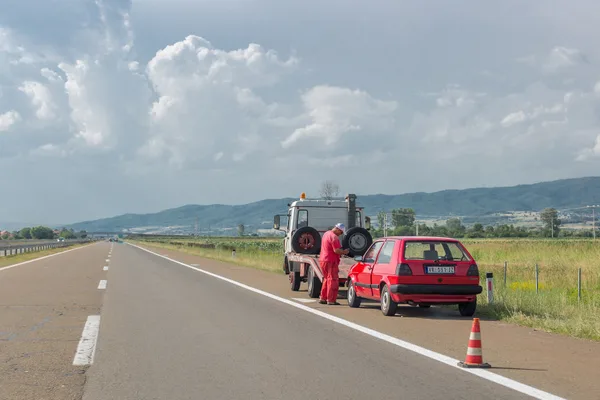
Before any tactic makes sense, get the shape of the demand right. A stranded driver is not researching, comparing quotes, or filling out a contact form. They are on the shoulder of a highway, in a parking lot, or in their driveway with a dead battery, and they want to tap a number and hear a truck is coming. The entire buying decision happens on a phone, usually in under two minutes, and it almost always ends in a call. That single fact reorganizes everything downstream.
This matters because most marketing playbooks are built for businesses where the goal is a form fill, a booked demo, or an email capture you nurture over weeks. Apply that to towing and you optimize the wrong thing. You count clicks and contact-form submissions while the actual money — the booked dispatch — walks out the door because the phone rang three rings too long or the number wasn't the first thing a panicked driver saw.
There's also a split in where towing revenue comes from, and a good system serves both. Retail emergency calls are high-intent, high-margin, and unpredictable. Recurring account work — motor clubs like AAA, insurance roadside programs, fleets, and dealerships — is steadier dispatch volume that smooths out the slow weeks. Motor clubs field tens of millions of roadside calls a year in the US, and a large share of those become tow assignments handed to local operators. The retail demand you build — your reviews, your reputation, your visibility — is also what makes account partners want to send you that work. So the system isn't 'ads versus accounts.' It's building retail demand that feeds both lines at once.
Map the demand: when, where, and how it spikes
A system that wins calls is built around when calls actually happen, and towing demand is sharply seasonal and weather-driven. Winter is the brutal season across Canada and the northern US: batteries lose a chunk of their cranking power as temperatures drop, and a large share of their capacity near zero, so cold snaps trigger a wave of dead-battery and jump-start calls, followed by snow extractions and winch-outs when storms hit. A single cold front can flood your line with the same job repeated a hundred times before noon.
Summer brings its own surge — heat-stressed batteries, blown tires, and holiday travel breakdowns — so demand peaks at both ends of the year with a quieter shoulder in spring and fall. The time-of-day pattern is just as real. Breakdowns cluster around commutes and after dark, and night-time tow requests run higher in winter. If your phone or your ad scheduling treats 2 a.m. like 2 p.m., you're invisible at the exact moment the most desperate, least price-sensitive calls come in.
Build the system to anticipate this. Ad budgets should flex up before and during forecasted cold snaps and storms, not react a week later. Your 24/7 availability needs to be loud and obvious in every listing and ad. And your service mix — light-duty, heavy-duty, recovery, lockouts, fuel delivery, motorcycle, EV — should each map to its own searches and its own season, because 'flat tire change near me' and 'heavy duty towing near me' are different buyers with different economics. The companies that win plan their visibility around the calendar and the weather radar, not a flat monthly schedule.
The funnel: from 'tow truck near me' to truck dispatched
The towing funnel is short and unforgiving, which is good news — there are only a few stages, and each one is fixable. Stage one is the trigger: a breakdown, accident, lockout, or flat. Stage two is a search, almost always on mobile, almost always with 'near me' or a city attached. Stage three is the choice, made in seconds, between the handful of results the driver can see. Stage four is the call. Stage five is whether your dispatcher actually books it. That's the whole journey.
Where does the money leak? Mostly at stages three and five. At stage three, if you're not in the Google map pack and near the top of the page, you don't exist — the driver calls whoever shows up first with strong reviews and an obvious phone number. A large share of local mobile searches end in a call or an in-person visit, so ranking in those top local results is where the calls are won. At stage five, an unanswered or fumbled call is a job handed straight to the competitor down the road.
A real system instruments every stage so you can see the leaks instead of guessing. Call tracking ties each ring back to the campaign, keyword, or listing that produced it. Call recording shows whether the phone was answered and whether the dispatcher actually booked the job or talked the driver out of it. Missed-call text-back fires an automatic message the moment a call goes unanswered, so the stranded driver hears from you in seconds — before they dial the next number on the list. None of this is exotic; it's the basic plumbing that turns 'we're getting calls' into 'we know our cost per booked job.'
The channels that win towing calls — and how they fit together
Four channels do the heavy lifting in towing, and they win when they're built as one system feeding a single dispatch line rather than four vendors pointing in different directions.
Google Business Profile and local SEO are the foundation. The map pack — those top three local results with stars and a call button — drives the bulk of emergency calls because that's what mobile searchers see and tap first. A fully optimized profile (correct categories, 24/7 hours, every service area, real photos, fresh reviews) is the single highest-leverage thing most tow companies can fix, and it earns calls you never pay per click for. Service-area and service-type pages on your site reinforce it for each town and each job you run.
Google Ads buy the top of the page when organic isn't enough — and in competitive metros, it rarely is at 2 a.m. in a snowstorm. Tightly structured campaigns target urgent intent ('tow truck near me,' '24 hour towing,' 'jump start near me') with call-only and call-extension formats that ring your phone directly. Set a budget per truck you actually want to keep busy, then let tracked calls — not a flat guess — tell you whether to spend more or pull back. Paid only earns its place once every call traces back to a campaign.
Reviews are the tiebreaker. When two companies are both in the map pack with similar ETAs, the driver picks the one with more recent 5-star reviews. An automated request after every job keeps that stream fresh, which lifts both rankings and conversion. And AI search (GEO) is the newest layer: when a driver asks ChatGPT, Gemini, or Google's AI Overviews 'who should I call for a tow near me,' the assistants lean on the same reviews, citations, and profile data — so the work you do for local SEO increasingly feeds AI recommendations too. SearchPod runs these four as one connected build for exactly this reason: the website, ads, SEO, and reviews share the same data and feed the same phone.
The website's only job: make calling effortless
Your towing website is not a brochure — it's a one-tap call machine, and it should be designed against that single job. Most tow company sites lose calls in the first three seconds because the phone number is buried, the page loads slowly on a weak roadside connection, or the layout makes a stranded, stressed driver hunt for the button. Fix those three things and conversion climbs before you spend a dollar more on traffic.
The non-negotiables are concrete. A giant tap-to-call button fixed to the top of the screen and sticky as the driver scrolls. A page that loads fast on a phone with two bars of signal, because every extra second on a roadside is a driver who backs out and calls the next result. A headline that answers the only two questions that matter — can you come now, and how fast — with your 24/7 promise and response area stated plainly. Trust signals near the button: review count and rating, years in business, the motor clubs and insurers you work with.
Structure the rest around the jobs and the geography. Separate, clearly labeled paths for light-duty towing, heavy-duty and recovery, roadside assistance, lockouts, and fuel delivery, so a driver — and Google — instantly sees you handle their exact situation. Service-area pages for each town you cover, so you rank and convert for 'towing in [town]' across your whole footprint. Click-to-call is the primary action on every single page; a contact form is at most a fallback for account inquiries and fleet partnerships, never the headline ask. The standard to build to is simple: a panicked driver should be able to reach you in one tap from any page, on any phone, in any weather.
The metrics that actually matter (and the ones that fool you)
Most towing marketing fails not because the tactics are wrong but because the wrong numbers get measured. Clicks, impressions, and 'website visits' feel like progress and tell you almost nothing about whether trucks are rolling. The metrics that run a profitable towing operation all trace back to the phone.
Cost per booked call is the headline number. Not cost per click, not cost per call — cost per call that became a dispatched job. You get there by tracking spend, calls, and outcomes together, which means call tracking on every channel and someone tagging which calls actually booked. The moment you can see that one number, you can tell which campaigns fill the board and which just burn budget. Track it by service type too, because a heavy-duty recovery and a quick jump-start have completely different economics, and a blended average hides where your real profit comes from.
The second metric is answer rate and booking rate on inbound calls. If a fifth of your calls go unanswered or get mishandled, no amount of ad spend fixes the leak — you're paying to generate jobs you then drop. Recording and scoring calls turns this from a hunch into something you can coach. Missed-call recovery — an automatic text-back on every unanswered call — directly recaptures revenue you'd otherwise lose to the next company on the list.
The third is the leading indicators that compound: review velocity (new reviews per month), map-pack ranking for your core 'near me' terms across each service area, and increasingly your visibility in AI answers. These don't pay off this week, but over three to six months they build a flow of calls you don't pay per click for. The discipline that separates winners is simple: judge every channel by booked calls and their true cost, and treat everything else as a diagnostic, not a goal.
Putting the system together in 2026
A towing marketing system in 2026 isn't a list of channels — it's those channels wired to one dispatch line and one set of numbers, run on a calendar that matches how breakdowns actually happen. Here's the sequence that holds up.
Start with the foundation that earns free calls: a fully optimized Google Business Profile and a fast, one-tap-to-call website with service-area and service-type pages for everything you run. Layer call tracking and missed-call text-back over it from day one, so every channel is measurable and no ring is wasted. Turn on Google Ads for urgent, high-intent searches to capture demand immediately while SEO and reviews are still compounding — paid gives you calls in weeks, organic gives you durable, cheaper calls over months, and running both from the start is the fastest stable path. Automate review requests after every completed job to feed rankings, conversion, and AI recommendations at once. Then flex the whole thing with the weather and the seasons: more budget and visibility before cold snaps, storms, and travel weekends, steady baseline in the quiet shoulder months.
Underneath all of it, keep the recurring-account engine running in parallel — the reputation and brand that win retail calls are the same assets that make motor clubs, insurers, fleets, and dealerships want to send you work, so you're never one lost account away from a slow month.
The reason to run these pieces as one system rather than five disconnected vendors is the same reason the system works at all: the data has to flow. SEO feeds AI search, reviews feed both, ads reveal which keywords are worth ranking for organically, and call tracking tells you the truth about every dollar. That's the approach SearchPod is built around for towing — website, ads, SEO, AI search, email, and reviews as one connected system, with every booked call tracked back to its true cost, and full ownership of your site, accounts, and data staying with you. Build it in that order, measure it by booked calls, and the dispatch board fills itself.