We adjust based on
the data,
not the mood.
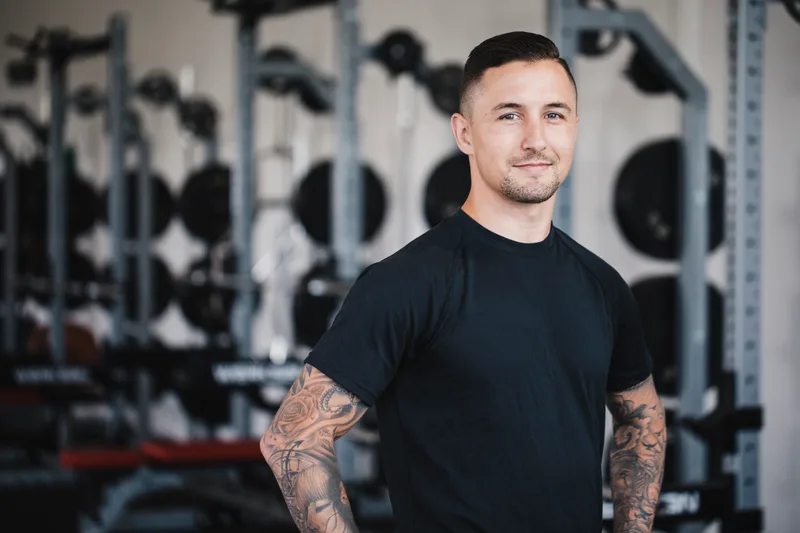
Coach Reuben is a 1:1 strength + body-composition coaching practice. NSCA-CSCS, Precision Nutrition L2. Currently working with 84 lifters worldwide on 8-week mesocycles and 12-week macros. Programming auto-regulates against RPE and recovery markers[1], not pre-set percentages — your loads come from your last six weeks, not the spreadsheet.
“Pull volume up next block. Sleep was the bottleneck — let’s protect Wed–Thu nights. Squat is moving well; bench needs intent. — R.”
Three
programs.
Pick by how high-touch you want the support, not by how hard you want to train. Every program runs the same architecture — accumulation / intensification / realization, RPE auto-regulated, app-delivered[2].
1:1 Strength
Hypertrophy → strength → realization. Block-based, RPE auto-regulated, weekly check-in. The default for the lifter who wants the numbers to climb without guesswork.
Hybrid · Body Composition
Body-comp work without losing the lifts. 4 strength sessions, 2 conditioning, structured meal targets, sleep-protocol check-ins. The most-chosen program.
Self-paced + Office Hours
Pre-built block, app-delivered. Bi-weekly office-hours call (45 min). For the lifter who needs the program but not the high-touch.
Four
principles.
The architecture under every program. Cited where citation is appropriate; honest about where the citation is just experience[4].
- 01 /
Auto-regulation, not chase-numbers
Every block uses RPE + RIR-based scaling. We hit prescribed loads when the bar is moving fast; we deload when it isn't. The chase-PR-every-session model breaks more lifters than it makes.[1]
- 02 /
MEV → MAV → MRV
Volume progresses through minimum-effective → maximum-adaptive → maximum-recoverable. Most blocks deload before MRV; the goal is repeat the block, not survive it.[2]
- 03 /
Sleep is the bottleneck
We track sleep duration and quality every check-in. When sleep drops below 7 hours for 4+ nights, we adjust volume — not because we want to, because the data shows recovery isn't there.[3]
- 04 /
n=1 informed by n=many
Your training is yours. The principles come from the literature; the loads come from your last six weeks. We don't rerun the same block on every athlete.[4]
- Helms et al., 'The Muscle and Strength Pyramid' (2019)
- Israetel et al., 'Scientific Principles of Strength Training' (2018)
- Walker, 'Why We Sleep' (2017); also Lyle McDonald 2020 review
- Coach's experience across 84 active athletes, 2018 — present

I’ve coached
347 lifters
since 2018.
I started coaching part-time in 2017 while finishing a master’s in exercise physiology, full-time since 2018. Eighty-four active athletes today; roster has averaged 70 — 90 since 2021 (I cap it at 100). Most are 28 — 45, busy professionals, intermediate to advanced lifters, hire me because they need the program + the accountability — not the community gym.
Match
to a program.
Five questions. Sixty seconds. We’ll match you to one of the three programs and send you the spec doc. No payment until intake call.
What's your primary goal?
Pick the one that matters most right now. We'll cover the others over time.
Training experience?
Be honest — I program differently for different starting points.
Realistic training frequency?
Don't tell me your dream — tell me what's sustainable for the next 6 months.
How much coaching support do you need?
1:1 is intimate but expensive. Self-paced is cheap but solo. Be honest about what you'll actually use.
Monthly budget for coaching?
Pick what works. No judgment — programs at every level.