About the coach
The coach behind the cap
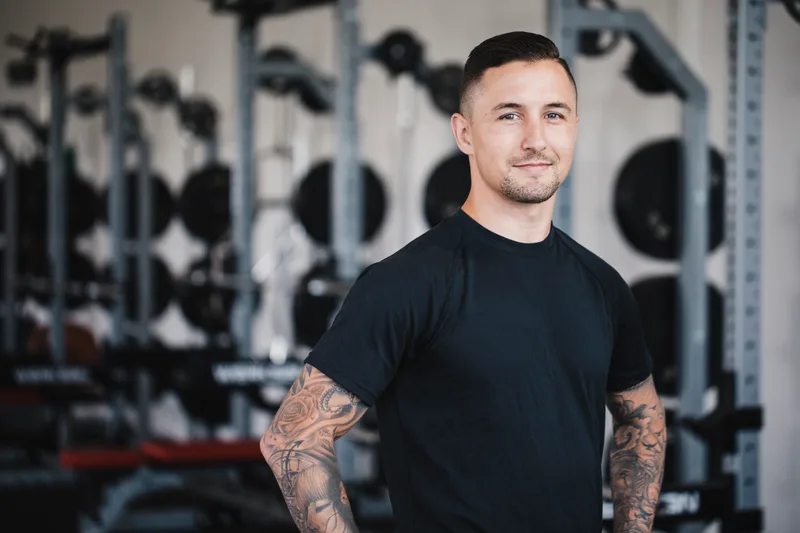
I'm Reuben Marsh. I've been coaching strength for eleven years — six of them on a commercial gym floor, the rest online, 1:1, with a roster that stopped growing at 45 because that's the honest limit of watching everyone properly.
Most of my roster is people with real constraints: shift work, old injuries with clearance letters, kids, a back with opinions. If your life is already optimized for training, you don't need me. If it isn't — that's my actual specialty.

The log so far
How this practice happened
-
2009
The injury that started it
A torn hip labrum ended my club rugby run at 22. Rehab introduced me to the barbell — and to how badly most training advice fits a body with history.
-
2011
The gym floor
Kinesiology degree by day, commercial-gym floor by night. Six years and 10,000+ sessions of watching real people move — desk backs, cranky knees, second kids, night shifts.
-
2015
Online, 1:1, on purpose
I took twelve floor clients online so they could keep training through job moves and life changes. Everyone stayed. That was the whole business plan.
-
2019
The roster cap
At 60 clients I caught myself skimming a check-in video. I cut the roster to 45 and it has never grown back. Skimming is programming; watching is coaching.
-
Today
Still 1:1, still watching
Every program is written from your assessment. Every check-in gets my eyes, not an assistant's, not an AI summary. That's the trade I make for charging what I charge.
Paper & floor hours
Credentials, briefly
Certifications matter — they're the floor, not the ceiling. The 10,000 in-person sessions matter more; that's where a form eye comes from.
- CSCS
- Certified Strength & Conditioning Specialist
- BSc Kinesiology
- Undergraduate degree in human movement science
- L1 Nutrition Coach
- Certified nutrition coaching, level 1
- Pain-informed training
- Continuing-ed focus: training around (not through) old injuries
- 10,000+ sessions
- In-person floor hours before going online — form eye built the slow way
The method
Four rules, one loop
The rules decide what goes in your program. The weekly loop decides how it changes. Neither is secret, neither is patented, and both only work when someone actually watches — which is the part you're paying for.
Assessment before prescription
You don't get a program until I've seen how you move, what you've trained, what's hurt, and what your week actually looks like. Anything else is a guess with your name typed on it.
The minimum effective dose
Three good sessions a week you actually do beats six imaginary ones. I program the least training that moves you forward — because the rest of your life is the point.
The log is the plan
Your training log — sets, loads, RPE, how it felt — decides what happens next week. The plan bends to the data. Programs that ignore your log are just PDFs with dates.
Strength is the anchor
Whatever the goal — first pull-up, return to sport, feeling capable at 50 — getting stronger is the through-line. It's the adaptation that makes every other one easier to keep.
The weekly loop
-
You train & log
Your week's sessions live in the app. You log loads, reps, RPE, and film the sets that matter.
-
I watch everything
Form videos get frame-by-frame voice notes. Your log gets read line by line — not skimmed.
-
Sunday check-in
You answer five questions about sleep, stress, appetite, and honesty-about-adherence. Takes ten minutes.
-
Next week adjusts
Monday morning your next block reflects what actually happened — not what was supposed to happen.
Full disclosure
Who I'm not
Coaching sales pages are usually a list of everything the coach claims to be. Here's the opposite list — it does more work.
I'm not a physio
I train people who've been cleared, and I collaborate with the clinicians who cleared them. If you're in pain and undiagnosed, a coach is the wrong first call — even this one.
I'm not a nutrition guru
You'll get evidence-based targets and one habit at a time, and that's it. No meal plans, no banned foods, no supplements funnel. My affiliate income is zero and staying there.
I'm not a content machine
Two journal posts a season, no daily motivational reels. The hours other coaches spend filming themselves, I spend watching your squat. It's a worse marketing strategy and a better coaching one.
I'm not scalable
No assistant coaches, no AI check-in summaries, no 'team of experts'. That means a roster cap and sometimes a waitlist. It also means the person you applied to is the person who answers.
Start here
If that sounded like your kind of coach —
— the assessment is free, takes six minutes, and gets a personal reply within two business days. And if it didn't sound like your kind of coach, genuinely: better to know now.
Roster capped at 45 · currently reviewing applications