Choosing stone that ages well in freeze–thaw country
March 2, 2026 · 7 min read · by Daniel Osei, Master Mason
Our winters run a hundred freeze–thaw cycles in a bad year. Water gets into stone, freezes, expands nine percent, and finds every weakness a quarry missed. Some materials shrug this off for a century; some spall into gravel in five seasons. The difference is rarely visible at the stone yard.
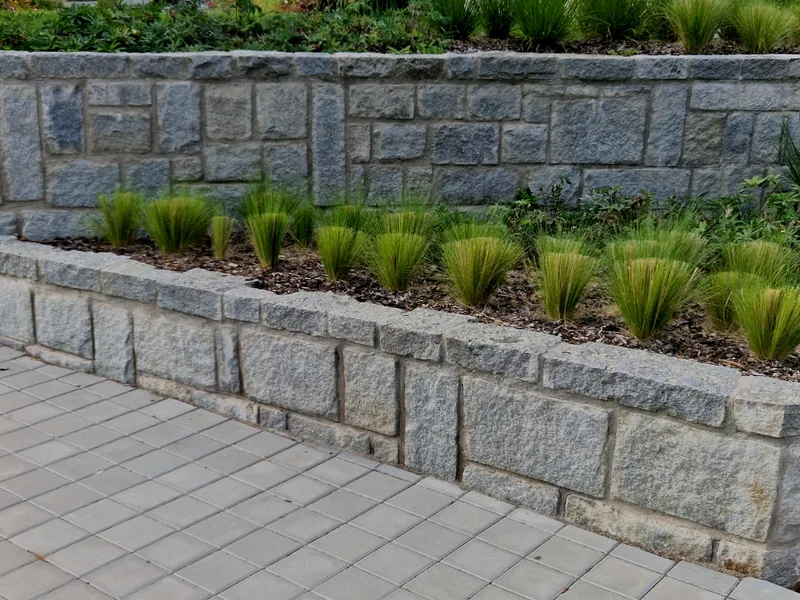
Granite is the honest one. Dense, nearly non-absorptive, and it doesn't care about your winter. Full-range setts — the mixed greys and buffs you see on our estate drives — will outlive the mortgage, the owners, and possibly the house. The cost is real, but so is the century.
Buy the stone for year ten, not for installation day. They all look good on installation day.
Bluestone, thermal or natural cleft
Bluestone is the classic tread and terrace stone, and it earns it — but specification matters. Thermal-finish stone from a dense bed handles freeze–thaw honourably; cheap natural-cleft stock from shallow beds delaminates in sheets. Ask where the stone was quarried and insist on seeing more than the sample board. A good yard will show you a pallet; a great one will tell you which bed it came from.
A good word for concrete
Modern architectural concrete deserves its moment. Large-format panels, properly specified with air entrainment and cured with patience, are dimensionally honest, freeze-tolerant, and quietly beautiful — the floor of our Ravine Farmhouse arrival is exactly this. The failures you've seen are almost always base failures, not concrete failures: the slab telegraphs whatever the ground beneath it does.
Which is the real secret of stone that ages well, whatever the material: the money is underground. Sixty tonnes of compacted base you'll never see is why the surface you do see stays perfect. Skimp anywhere but there.
Questions about your own garden? The walk-through is free — and Daniel Osei occasionally tags along.