Research, concepts, refinement, and delivery. What to expect from a professional logo design engagement.
Why the Logo Design Process Matters More Than the Designer
Two businesses hire equally talented designers. One gets a mark they’re still proud of a decade later; the other gets three rounds of frustration and a logo everyone quietly resents. The difference is almost never raw talent — it’s process. A logo is a small, dense artifact that has to encode positioning, survive every size from a favicon to a billboard, and stay legible long after the trend that inspired it has died. Designs that carry that load are arrived at, not conjured, and the route is surprisingly consistent across good studios: brief, research, concepts, refinement, delivery.
Understanding that route matters as much for clients as for designers. Most failed logo projects fail at handoff points — a brief that was never written down, feedback delivered as “make it pop,” final files that turn out to be a single JPEG on a white background. When you know what each stage is supposed to produce, you can tell within the first week whether an engagement is on rails or headed somewhere expensive.
This walkthrough covers the full arc of a professional logo engagement: what a real brief contains, what the research phase is actually for, how concepts get developed and presented, how to give feedback that improves the work, and — the part most articles skip — exactly which files, formats, and legal rights you should walk away with when the project closes.
The Design Brief: Where Good Logos Are Actually Won
Every hour spent on the brief saves several in revisions, because the brief is the document every later disagreement gets resolved against. Without one, feedback collapses into personal taste — yours versus the designer’s — and personal taste arguments have no exit. With one, the question is never “do you like it?” but “does it do what we agreed it needs to do?”
A working brief answers a short list of hard questions. What does the business actually do, and for whom? What should someone feel in the first second of seeing the mark — established or upstart, premium or accessible, warm or precise? Who are the direct competitors, and what do their logos look like? Where will the logo live most of the time — a truck door, an app icon, a storefront, a pitch deck? Are there existing constraints: a name that isn’t changing, a colour the owner refuses to give up, an old mark with real equity that should evolve rather than vanish?
The most useful brief questions are the uncomfortable ones. “What should this logo never be mistaken for?” surfaces positioning faster than any mood board. “Which competitor’s branding do you secretly envy?” reveals the actual ambition. “Who has veto power on this decision?” prevents the classic disaster where a spouse or silent partner appears in round three with a completely different vision.
Expect a good designer to push back during this phase. If you say “modern and timeless, bold but minimal, fun but professional,” a serious practitioner will make you choose, because a brief that contains every adjective constrains nothing. Vague briefs don’t produce flexible logos; they produce safe, forgettable ones.
Research and Discovery: Mapping the Visual Territory
Before anything gets sketched, the designer should spend real time understanding the landscape the logo has to live in. This isn’t padding on the invoice — it’s the work that separates a mark designed for your market from clip-art with your name under it.
Competitive audit comes first. If every plumbing company in your city uses a blue wrench, a blue wrench guarantees invisibility; if every competitor shouts in heavy red type, restraint becomes a differentiator. The designer maps what the category looks like — common colours, common symbols, common typography — specifically to find the open space. Distinctiveness is the single most commercially valuable property a logo can have, and you can only design for it after you know what everyone else looks like.
Discovery also covers the practical terrain: every surface the logo must work on, from embroidery on a uniform (which punishes fine detail) to a 16-pixel favicon (which punishes complexity) to vehicle wraps and signage viewed at distance. A mark designed without knowing its destinations tends to fail at exactly the size the client cares about most.
Many designers consolidate this phase into mood boards or stylescapes — collages of typography, colour, texture, and existing marks that say “somewhere in this direction.” Reviewing these before any logo exists is cheap insurance: agreeing on a visual direction at the mood-board stage costs an email; discovering a fundamental disagreement after three finished concepts costs weeks. If your designer offers this step, take it seriously.
Concept Development: Sketches, Directions, and Why Fewer Is Better
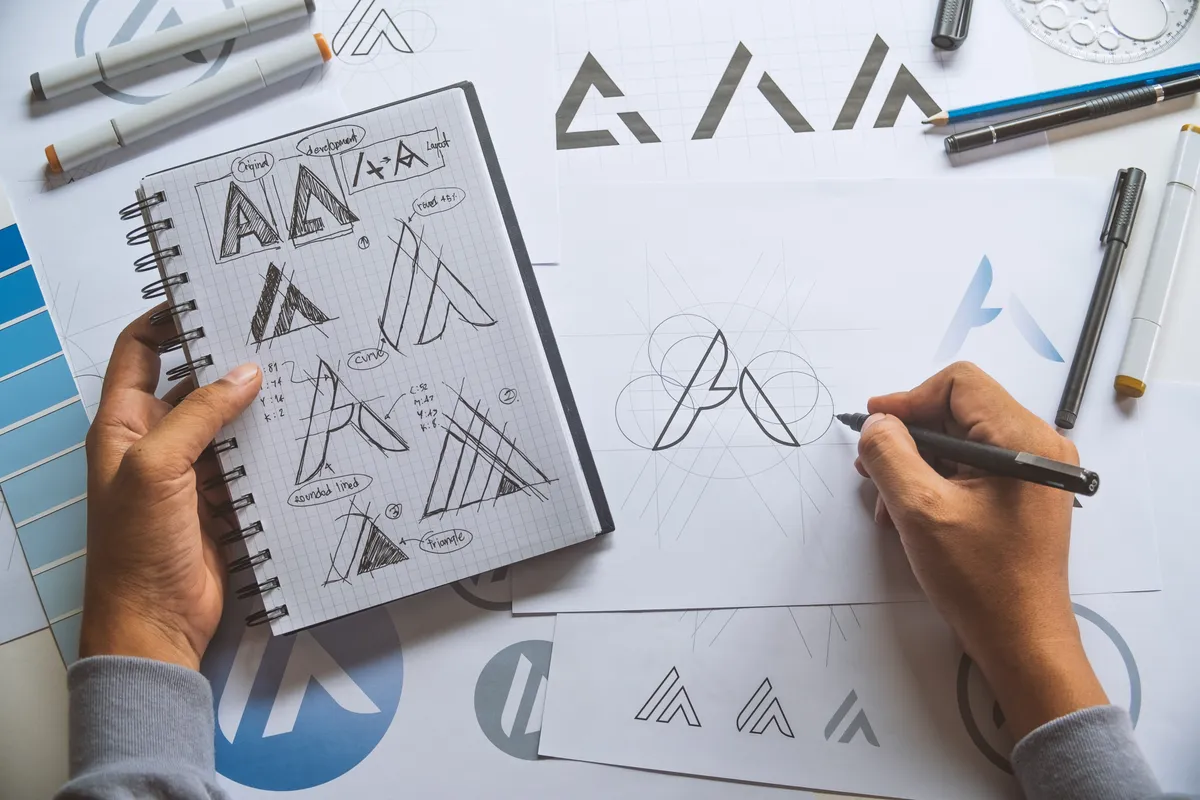
Real concept work starts on paper, or at least it should. Sketching is fast and disposable, which makes it the right medium for the dozens of bad ideas that have to be exhausted before the good ones surface. Designers who jump straight into software tend to fall in love with the first rendering that looks polished, and polish is not the same thing as a strong idea. A strong logo concept survives the ugliest possible drawing of itself.
From that exploration, the designer develops a small number of directions into presentable concepts — typically two or three, occasionally one with strong rationale. Counterintuitively, more options is a red flag, not a bonus. A designer presenting eight concepts hasn’t done eight times the thinking; they’ve outsourced the editing to you. Three well-argued directions, each solving the brief differently, signals that judgment was applied before the meeting. Marketplaces that promise dozens of concepts for a few hundred dollars are selling volume, and volume at that price is recycled templates.
Each concept should arrive as more than a mark floating on white. Expect to see it in one colour, in black and white, at small sizes, and mocked up in context — on the storefront, the website header, the business card — because context is where weak ideas expose themselves. Expect rationale, too: why this shape, why this typeface, how it answers the brief. A designer who can’t explain a concept in terms of your business made an art piece, not a logo.
During this stage the designer is also quietly checking each direction against the practical gauntlet: Does it work without colour? Does it reduce? Is it legible in a sliver of peripheral vision? Does it resemble anything notorious? Concepts that fail those tests die before you ever see them — which is precisely the value you’re paying for.
Presentation and Feedback: How to Respond Without Wrecking the Work
Feedback is where clients have the most power to help or harm a logo project, and the difference comes down to one habit: describe problems, not solutions. “The mark feels too playful for the price point we charge” is feedback a designer can act on intelligently. “Make the swoosh bigger and try orange” is a prescription that may or may not address whatever was actually bothering you — and it converts your designer into a pair of hands instead of a brain.
Anchor every reaction to the brief. Before saying you don’t like a concept, ask whether it does what the brief asked. Sometimes the honest answer is that the concept meets the brief and the brief was wrong — that happens, and it’s far better to say so explicitly and revise the brief than to chase the discomfort through six rounds of mutations. Sometimes the answer is that the concept genuinely misses, and pointing at the specific gap (“we said established; this reads startup”) gives the revision a target.
Consolidate voices before responding. The single most destructive pattern in logo work is serial feedback — one stakeholder’s notes this week, a different stakeholder’s contradicting notes the next. Decide internally, send one unified response, and resist polling the office, your family, or social media. Crowds reliably select the most familiar option, and familiar is the opposite of what you hired a designer to produce.
Finally, give concepts a day before reacting. First impressions of unfamiliar marks skew negative because unfamiliarity itself feels wrong; some of the most durable logos in your own life would have lost an instant-reaction poll. Your engagement will include a defined number of revision rounds — typically two or three — and they are for refinement, not for restarting. If you find yourself wanting a fourth concept that resembles none of the first three, the problem is upstream in the brief, and the honest fix is a paid scope conversation, not attrition.
Refinement: Stress-Testing the Chosen Direction
Once a direction is chosen, the work shifts from creative to forensic. Refinement is where a promising concept becomes a professional mark, and most of it is invisible to anyone who wasn’t in the room.
The designer tunes the geometry — letterspacing, stroke weights, optical corrections that make mathematically equal shapes look equal to the human eye — and builds out the system around the mark. A finished logo is never one image. At minimum you should see a primary lockup (symbol plus wordmark in their main arrangement), a secondary or stacked lockup for narrow spaces, a standalone symbol or submark for avatars and favicons, and clear rules for when each applies.
Colour gets formalized into exact specifications — values for screen and print — alongside a true one-colour version and a reversed version for dark backgrounds. The one-colour test matters more than clients expect: embroidery, engraving, stamps, newsprint, and sponsor walls all strip your palette away, and a logo that depends on a gradient to be recognizable will spend half its life unrecognizable.
Then comes scale testing: the mark at favicon size, on a phone screen, on letterhead, and blown up on signage. Fine details that sing at poster size clog into mud at sixteen pixels, which is why many marks ship with a simplified small-size variant. A careful designer also runs trademark-adjacent sanity checks — reverse image searches, a look through obvious competitors — not as legal clearance, which is a lawyer’s job, but to avoid presenting you a mark that’s one Google search away from embarrassment.
Final Files: The Exact Deliverables You Should Receive
This is where many engagements quietly fail, so be specific in the contract: a logo project ends with a file package, not a picture. If you receive a single PNG, you do not yet have a logo — you have a screenshot of one.
The non-negotiable core is vector source files. Vector formats — AI (Adobe Illustrator), EPS, SVG, and vector PDF — describe the mark mathematically, so it scales from a button to a building wrap with zero quality loss. Every future need, from a sign shop to a swag vendor to a website rebuild, starts with “send us the vector.” SVG matters doubly because it’s also the format modern websites render natively. If your designer worked in Illustrator, ask for the working file with text converted to outlines, so the artwork doesn’t depend on fonts you don’t own.
On top of the vectors, expect rendered raster files for everyday use: high-resolution PNGs with transparent backgrounds in several sizes, plus JPEGs for contexts that don’t support transparency. The full matrix is every lockup (primary, secondary, submark) in every colour treatment (full colour, one-colour dark, one-colour light/reversed) in both vector and raster — organized in folders with sane names, not a zip of files called final_v3_FINAL2.
Colour variants should come built for both worlds: RGB and hex values for screens, CMYK for professional printing, and ideally Pantone references if your brand colour needs to match exactly across printers. Expect the package to name the typefaces used and state their licensing — fonts are licensed software, and a designer’s licence usually does not transfer to you, so you may need to buy your own seat for the brand typeface.
The last deliverable is a brand sheet or mini style guide: a few pages covering logo variants and when to use each, clear-space and minimum-size rules, colour codes, typefaces, and the most common misuses. It’s the document that keeps your logo intact once it’s in the hands of every future vendor, employee, and printer you’ll never meet.
Ownership, Copyright, and Trademark: Who Actually Owns Your Logo
Here’s the part that surprises business owners: paying for a logo does not automatically make you its owner. Under copyright law in Canada and most jurisdictions, the creator of a work owns the copyright by default, and an independent contractor — which is what a freelance designer or an agency is — retains it unless a written agreement assigns it to you. Plenty of businesses have operated for years on what is legally a permission slip rather than ownership, and only discovered the gap during a sale, an investment round, or a falling-out with the original designer.
The fix is one clause: the contract should state that, upon final payment, full copyright in the final approved logo is assigned to you in writing. In Canada, copyright assignments must be in writing to be valid, so a verbal “of course it’s yours” doesn’t do the job. It’s normal and fair for the assignment to cover the final mark only — designers customarily retain rights to the unchosen concepts and the right to show the finished work in their portfolio. Both are standard; neither threatens you. What you should never accept is ongoing licensing fees for your own primary logo or ambiguity about what happens if the studio closes.
Copyright is also not trademark, and the distinction matters. Copyright protects the artwork itself from being copied; a trademark protects the mark as a commercial identifier in your industry, and it’s what stops a competitor from using something confusingly similar. Your designer cannot grant you a trademark — registration goes through CIPO in Canada (or the USPTO in the US) and is worth a conversation with a trademark professional once the logo is final, especially before you spend heavily on signage and inventory. Designers can reasonably warrant that the work is original; they can’t warrant that it’s clear to register, because clearance searching is legal work.
One more quiet trap: logos built inside subscription platforms or AI logo generators often come with terms that limit exclusivity or commercial rights — read them before you build a business on the output.
Timelines, Budgets, and the Red Flags Worth Walking Away From
A professional logo engagement for a small business typically runs three to six weeks end to end — roughly a week for brief and research, one to two for concepts, one to two for refinement rounds, and a few days for file production and handoff. Identity systems with broader scope run longer. Anyone promising a finished, researched, original mark in 48 hours is skipping the stages that make it any of those three things.
Pricing varies enormously because scope does: a freelance designer, a small studio, and a brand agency are selling different depths of research and system. What stays constant across every legitimate price point is the shape of the process you’ve just read — a real brief, visible research, justified concepts, structured revisions, complete files, written IP assignment. Use the process, not the portfolio alone, as your evaluation tool.
The red flags are remarkably consistent. No questions about your business before quoting. No written brief or contract. Dozens of concepts promised upfront. Unlimited revisions, which sounds generous and actually signals that nobody intends to defend the work. Final delivery as raster files only, vectors withheld or sold back at ransom. Silence on copyright assignment. Fonts used without naming the licence. Concepts that look suspiciously like a stock-template search for your industry — run a reverse image search before approving anything.
The green flags are their mirror image: a designer who interrogates the brief, shows fewer concepts with stronger rationale, presents marks in context and in black and white before showing colour, builds in defined revision rounds, and hands over an organized file package with an assignment clause they brought up before you did. A logo done this way isn’t just a nicer mark — it’s an asset you legally own, in files every future vendor can use, built on decisions you can explain. That’s what the process buys, and it’s why the process is the product.