Comprehensive exams · $135 · 45 min
What an eye exam includes when nobody is rushing it.
“Comprehensive” gets used loosely. Here is the actual list — every item, every exam — so you can compare it against wherever you went last.
The seven parts of a Sightline exam
-
History + what you actually do all day
Screens, driving, night shifts, hobbies, medications, family eye history. A prescription that ignores your day is a prescription you’ll fight with.
-
Refraction — the “which is better, one or two”
The classic phoropter work, done unhurried. We refine until the answer is confident, not until the schedule says stop.
-
Binocular vision + focusing check
How your eyes aim, team, and sustain focus together. This is the part school screenings and kiosk refractions skip — and where headaches and reading fatigue usually hide.
-
Eye health, front of the eye
Slit-lamp microscopy of your lids, cornea, and lens — where dry eye, allergy, and early cataract show themselves.
-
Eye pressure, without the puff
Modern rebound tonometry: no air blast, no drama. Pressure matters because glaucoma is symptom-free until it isn’t.
-
Retina, photographed — included
Wide-field retinal photos of the back of your eye, kept on file so next year has a baseline. At many clinics this is an add-on; here it’s the exam.
-
The conversation
You leave with your prescription (automatically — it’s yours), the photos on screen, and a plain-language read of what we found and what, if anything, to do about it.
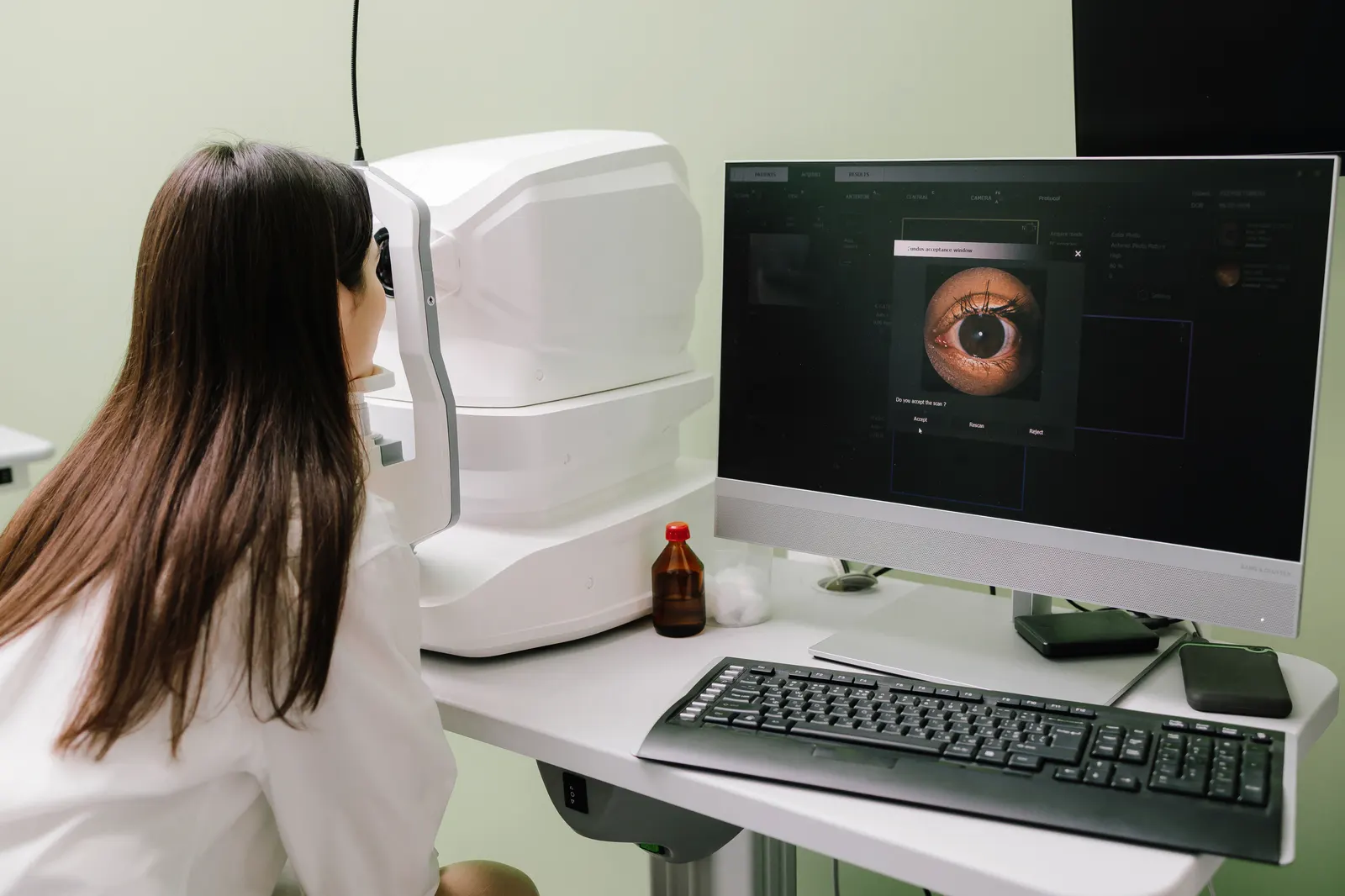
The OCT scan, explained
An ultrasound’s idea, done with light.
OCT takes a cross-section of your retina — layer by layer, in microns — the way an ultrasound slices through tissue. Retinal photos show the surface; OCT shows what’s happening underneath it: early macular changes, glaucoma damage to the nerve fibre layer, fluid where fluid shouldn’t be.
Here’s our honest position: not everyone needs one every year. We recommend OCT when something on your photos, pressures, family history, or symptoms makes the extra depth worth $45 — and we’ll show you the reason on screen before we scan. Some clinics bundle it into every visit and price accordingly; we’d rather keep the exam $135 and use imaging like a tool instead of a toll.
The fee, without asterisks
$135, and here’s what it doesn’t hide.
The $135 covers everything in the list above, retinal photos included. OHIP pays instead of you if you’re 19 or under, or 65 and over — once a year, with a valid health card. Most workplace vision plans cover some or all of the adult fee, and we bill them directly from the front desk.
The only things that ever cost extra are the ones with their own line on our fee table — like OCT ($45) or a visual field test ($40) — and each comes with a stated clinical reason first.

Before you book
Some eyes shouldn’t wait for an appointment.
Eye emergency — do not book online
- Sudden vision loss or a grey curtain / shadow moving across your vision — in one eye or both
- A sudden shower of new floaters, flashes of light, or both
- An eye injury, a chemical splash, or something embedded in the eye
- Severe eye pain with headache, nausea, or halos around lights
- Double vision that started suddenly
These can signal a retinal detachment, angle-closure glaucoma, or another problem where hours matter. During clinic hours call us and say the word “urgent” — we hold room in every day’s schedule. After hours, go straight to the nearest emergency department. Do not book online and wait.
Next available this week
Book an eye exam that earns the word “comprehensive.”
Online booking takes about a minute. Direct billing to most vision plans, retinal photos included, and nobody upsells you at the till.