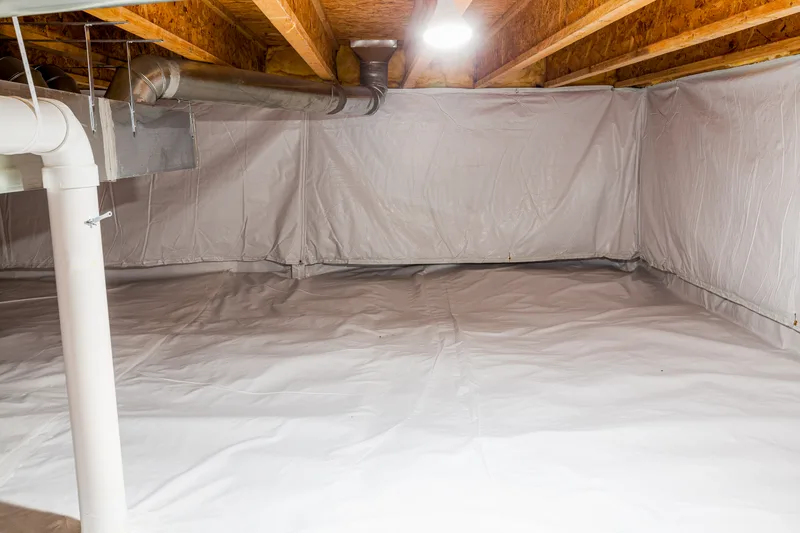
A crawl space is the short space under some homes and additions. When it has a dirt floor, open vents or a torn plastic sheet, damp air rises into the house. That is where a lot of musty smells and cold floors come from.
Encapsulation means sealing that space: a thick vapour barrier on the floor and up the walls, sealed vents and gaps, and a dehumidifier when the readings call for one. Not every crawl space needs the full system, and we will tell you if yours does not.
Signs
What you might be seeing
- A musty smell in the rooms above
- Cold or bouncy floors over the crawl space
- Torn, loose or missing plastic on the ground
- Standing water or mud after rain
- Joists that feel damp or show mould spots
- Mice or other pests getting in through open vents
Honest sorting
Simple fix or full system?
- A torn barrier in an otherwise dry crawl space: replace the barrier
- Damp only near one wall below a downspout: fix the downspout
- Musty smell from one wet insulation batt
- Joists or beams that are soft, cracked or sagging
- Posts that have sunk or tilted
- Wood moisture readings above about 19 percent across the space
Rough guides from our inspections, not engineering rules. We measure before we tell you which side yours is on.
Not sure which group yours is in?
A free inspection measures it. You get the readings and the answer in writing, even if the answer is "leave it alone."
Method
How we fix it
-
01
Clean and dry the space
We remove old plastic, wet insulation and debris, and fix any outside drainage that is sending water in.
-
02
Seal the floor and walls
A reinforced 12 to 20 mil vapour barrier goes down, overlaps at every seam and is sealed to the walls and posts.
-
03
Close vents and gaps
Vents and rim gaps are sealed and the rim joist gets rigid foam insulation, so humid outside air stops feeding the damp.
-
04
Control the air
Where the readings call for it, a crawl space dehumidifier holds humidity near 50 to 55 percent. Wet crawl spaces also get a small sump.
Prices
Price ranges
Planning ranges in Canadian dollars for typical Ottawa-area homes, HST extra. Your written quote after the inspection is a fixed price.
| Job | Range (CAD) |
|---|---|
| Vapour barrier replacement Floor only, up to about 600 sq ft | $2,200–$4,500 |
| Full encapsulation Floor, walls, vents and rim joist | $6–$11 per sq ft |
| Crawl space dehumidifier Installed, with drain line | $1,900–$3,200 |
| Crawl space sump pump When water collects | $1,400–$2,600 |
| Sagging joist or beam support Per adjustable steel post, with footing | $450–$900 |
Typical total
Most full crawl space encapsulations we do run $6,500 to $15,000. A barrier-only job is often under $4,500.
Honesty note
Crawl spaces with less than 60 cm of clearance take longer and cost more. If there is mould on the wood, a remediation partner cleans it first, priced on its own line.
Warranty. Vapour barrier: 20 years, transferable. Dehumidifier: 5-year maker's warranty plus 2 years of our labour. Read the terms
Questions
Questions about crawl spaces
Will encapsulation fix my musty smell?
If the smell comes from the crawl space, it usually does. We test humidity first. If the source is somewhere else, like a plumbing leak, we will say so.
Do I need a dehumidifier?
Only if readings stay above about 60 percent after sealing. Many sealed crawl spaces in our area stay dry without one in the cooler months.
Can I still store things down there?
Yes. The barrier is tough enough to crawl on and set bins on. We keep a clear path to the access door.
More answers on the FAQ page, or call (613) 555-0148.