Every house settles a little. Most of that movement happens in the first few years and then stops. Foundation repair is for movement that keeps going: a wall that leans in, a corner that keeps sinking, or floors that get less level year after year.
We start with numbers, not a pitch. We take floor-level readings across the main floor, measure every crack and check the walls for lean. If the readings say your house has stopped moving, we tell you, and the report says so in writing.
Signs
What you might be seeing
- Stair-step cracks in a block wall that are wider at one end
- A horizontal crack along the middle of a basement wall
- A wall that bows or leans inward
- Floors that slope, with doors that swing shut on their own
- Gaps above doors, or between window frames and walls
- Cracks in brick or drywall that come back after patching
Honest sorting
Cosmetic or structural?
- Thin vertical cracks in poured concrete, under 3 mm and not getting longer
- Small diagonal drywall cracks at the corners of doors and windows
- Doors that stick only in humid summer months
- Hairline cracks in the basement floor slab (the slab does not hold up the house)
- A horizontal crack, or any crack where one side has pushed out past the other
- Stair-step cracks wide enough to fit a pencil (about 6 mm)
- A wall that leans in more than about 25 mm from top to bottom
- Floors that drop more than 25 to 40 mm across a room, with cracks above
Rough guides from our inspections, not engineering rules. We measure before we tell you which side yours is on.
Not sure which group yours is in?
A free inspection measures it. You get the readings and the answer in writing, even if the answer is "leave it alone."
Method
How we fix it
-
01
Wall anchors
A steel plate inside the wall, a rod through the soil, and an anchor in stable ground outside. Tightened over time, anchors hold a bowing wall and can ease it back.
-
02
Steel or carbon fibre wall braces
For walls with a small lean and no room to dig outside. Braces bolt to the floor and the joists above and stop further movement. Carbon fibre straps sit flat and can be finished over.
-
03
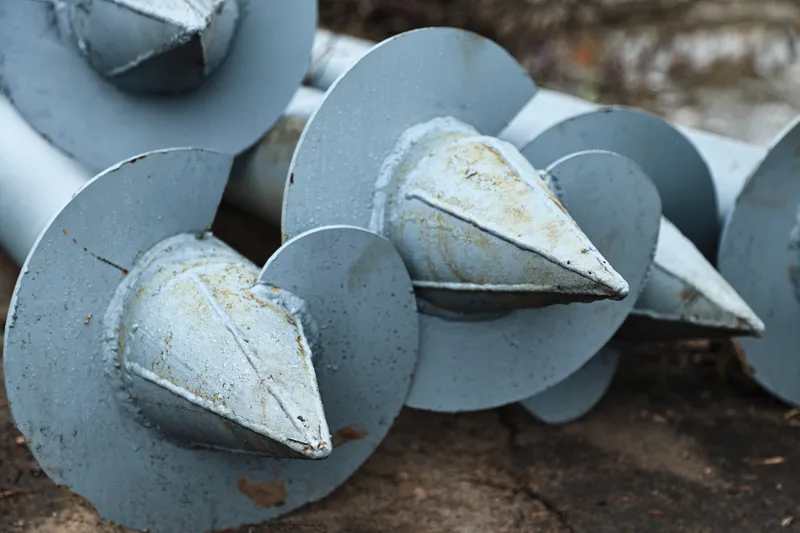
Helical and push piers
Steel piers driven or screwed down to firm soil or rock, then tied to the footing with brackets. They carry the weight of a sinking corner and can lift it back toward level, as far as is safe.
-
04
Engineer review and permit
When a repair involves piers or more than one wall, an independent structural engineer reviews the plan and we pull the City permit. The engineer's fee is its own line on your quote.
Prices
Price ranges
Planning ranges in Canadian dollars for typical Ottawa-area homes, HST extra. Your written quote after the inspection is a fixed price.
| Job | Range (CAD) |
|---|---|
| Carbon fibre wall strap Per strap, usually spaced about 1.2 m apart on a bowing wall | $650–$1,000 |
| Steel wall brace Per brace, bolted to the floor and the joists | $750–$1,250 |
| Wall anchor Per anchor, includes the outside dig and yard restoration | $850–$1,400 |
| Helical or push pier Per pier; most sinking corners need 3 to 6 | $2,200–$3,800 |
| Engineer review and permit When the repair needs it; passed through at cost | $600–$1,500 |
Typical total
Most foundation repairs we do in the Ottawa area land between $4,500 and $22,000. Bigger jobs exist, and we say so at the inspection, not on the invoice.
Honesty note
Ranges assume normal access. Decks, additions, tight side yards and buried services can add cost. You will see each of those lines on the written quote before you sign anything.
Warranty. Piers, anchors and braces: 25 years on the stabilization, transferable to the next owner. Read the terms
Questions
Questions about foundation repair
Does every crack mean I need foundation repair?
No. Most cracks we see are shrinkage cracks from when the concrete cured. They can leak, but they are not structural. The report sorts each crack for you.
Will piers lift my house back to level?
Often part of the way. We lift slowly and stop when the house tells us to, usually when drywall or windows start to resist. Forcing a house level can do more harm than the settling did.
How long does the work take?
Wall braces and straps take 1 to 2 days. Piers usually take 2 to 4 days. You can stay home the whole time.
More answers on the FAQ page, or call (613) 555-0148.