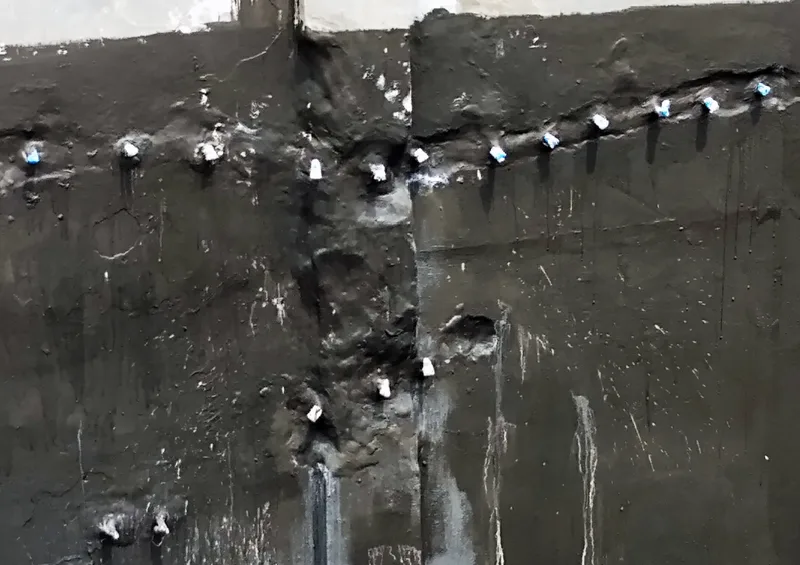
Most poured concrete walls crack as they cure. These thin, mostly vertical cracks are normal. They only become a problem when water gets through them.
We measure each crack, log its width and pattern, and tell you which group it is in: leave it and watch it, seal it so it stops leaking, or stabilize it because it is moving.
Signs
What you might be seeing
- A vertical or slightly diagonal crack in a poured wall
- Water or a damp stripe running down from a crack
- A crack that has grown since you last looked
- Stair-step cracks in a block wall
- Cracks that reopen after patching
- Cracks at the corners of basement windows
Honest sorting
Cosmetic or structural?
- Hairline vertical cracks under 3 mm, dry, not growing
- Cracks in the floor slab with no height change
- Old cracks sealed years ago that have stayed closed
- Horizontal cracks in block or poured walls
- Cracks wider at one end, or with one side pushed out
- Cracks that grow over a few months (we can fit a gauge to check)
Rough guides from our inspections, not engineering rules. We measure before we tell you which side yours is on.
Not sure which group yours is in?
A free inspection measures it. You get the readings and the answer in writing, even if the answer is "leave it alone."
Method
How we fix it
-
01
Measure and log
We record width, length and pattern, and photograph each crack with a scale. For a crack we are unsure about, we fit a simple gauge so you can watch it.
-
02
Polyurethane injection
For leaking cracks. Foam fills the crack from the inside through small ports and stays flexible, so it keeps sealing if the crack moves a little.
-
03
Epoxy injection
For cracks that need strength back as well as a seal. Epoxy bonds the two sides of the crack together again.
-
04
Carbon fibre stitches
For cracks that are slowly widening. Low-profile stitches across the crack stop it opening further and can be painted over.
Prices
Price ranges
Planning ranges in Canadian dollars for typical Ottawa-area homes, HST extra. Your written quote after the inspection is a fixed price.
| Job | Range (CAD) |
|---|---|
| Crack assessment with gauge Part of the free inspection | Included |
| Polyurethane injection Leaking crack, up to about 2.5 m long | $550–$950 |
| Epoxy injection Per crack, strength and seal | $700–$1,200 |
| Carbon fibre crack stitches Per crack, stitches about every 30 cm | $650–$1,100 |
| Outside crack seal When the wall must be dug out to the footing | $1,800–$3,500 |
Typical total
Most single cracks are fixed in an afternoon for $550 to $1,200.
Honesty note
Cracks behind finished walls need a small opening to reach. We cut a neat access panel and price the patch on its own line.
Warranty. Injected cracks: 10 years per crack, transferable. Read the terms
Questions
Questions about crack repair
Can I just caulk the crack myself?
For a dry hairline crack, a bead of sealant to keep dust out is fine. Surface caulk on a leaking crack usually fails within a season, because the water is pushing from the outside.
How do I know if a crack is growing?
Mark both ends with a pencil and the date, and take a photo with a coin beside it for scale. Check every few months. If it grows past your marks, call us.
Is a cracked wall a reason not to buy a house?
Usually not. Most cracks are normal. An inspection during your condition period can tell you which kind you are looking at.
More answers on the FAQ page, or call (613) 555-0148.