The Pivot method
Testing gates, not calendar dates
Every athlete moves through the same four phases — what changes is the tissue, the sport, and the numbers. The phases advance on testing gates, not calendar dates, and post-op athletes advance only with their surgeon's clearance.
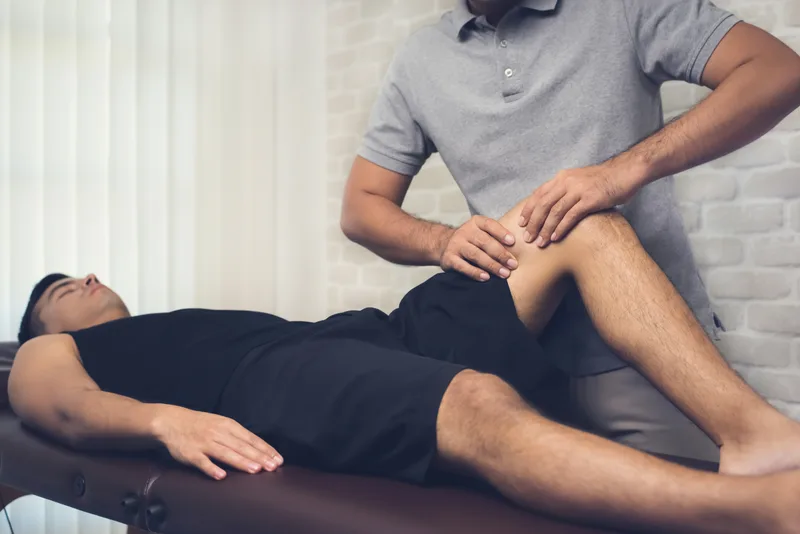
Assess — know exactly where you are
A 75-minute evaluation: your story, your sport's demands, and a baseline test battery — strength, range, swelling, single-leg control, and the numbers on your uninjured side, because that's the standard we rebuild to. Post-op athletes start inside their surgeon's protocol; we report findings back to the surgical team.
What we measure
- Side-to-side strength baseline
- Range of motion & swelling status
- Single-leg balance and control
- Sport demands profile (cut, land, throw, endure)
Rebuild — load management, not rest
Tissue calms down while capacity goes up. We find the heaviest load your injury tolerates today and progress it on a schedule — heavy slow resistance for tendons, graded impact for bone, protected range for repairs. You keep training everything that isn't hurt.
What we measure
- Weekly load progression targets
- Pain-during / pain-after response rules
- Strength retest every 4–6 weeks
- Cross-training plan to hold fitness
Retrain — make it look like your sport
Strength becomes speed, landing, and direction change. Plyometric progressions, deceleration and cutting mechanics, throwing or gait progressions — built from your sport's actual demands, coached rep by rep, filmed when the details matter.

What we measure
- Jump / hop test battery vs. baseline
- Deceleration & change-of-direction quality
- Sport-specific capacity (mileage, minutes, throw counts)
- Confidence check-ins — hesitation is data
Return — test out, don't age out
Return is a test result, not an anniversary. We run a criteria battery — strength symmetry ≥90%, hop tests, sport-specific capacity, and a psychological readiness check — then stage the comeback: practice before play, minutes before starts. Post-op athletes return only with their surgeon's clearance.
What we measure
- ≥90% limb symmetry, strength & hops
- No reactive swelling after sport drills
- Psychological readiness score
- Staged exposure plan: practice → minutes → starts
Why gates, not dates
The research moved. Most rehab didn't.
≥90%
Limb symmetry across strength and hop testing is the widely used bar before return — athletes who feel 100% routinely test far below it.
~9 mo
For ACL reconstruction, research keeps landing on roughly nine months as the earliest sensible return window — with testing, not instead of it.
3 of 3
Modern return decisions weigh physical capacity, sport-specific function, and psychological readiness. Fear of re-injury is measurable — and trainable.
Plain-language summary of published return-to-sport research; not medical advice. Your numbers, your sport, and — after surgery — your surgeon's protocol decide your plan.
Post-op athletes
Your surgeon's protocol is the law of the early phases — we follow it exactly, send progress reports at every gate, and never advance a post-op athlete without the surgical team's sign-off. Cleared by your surgeon first isn't fine print here; it's the method.
How post-op rehab works at PivotPhase one is an appointment.
The 75-minute evaluation sets your baseline and your plan — and if we're not the right clinic for your goal, we'll say so on day one.