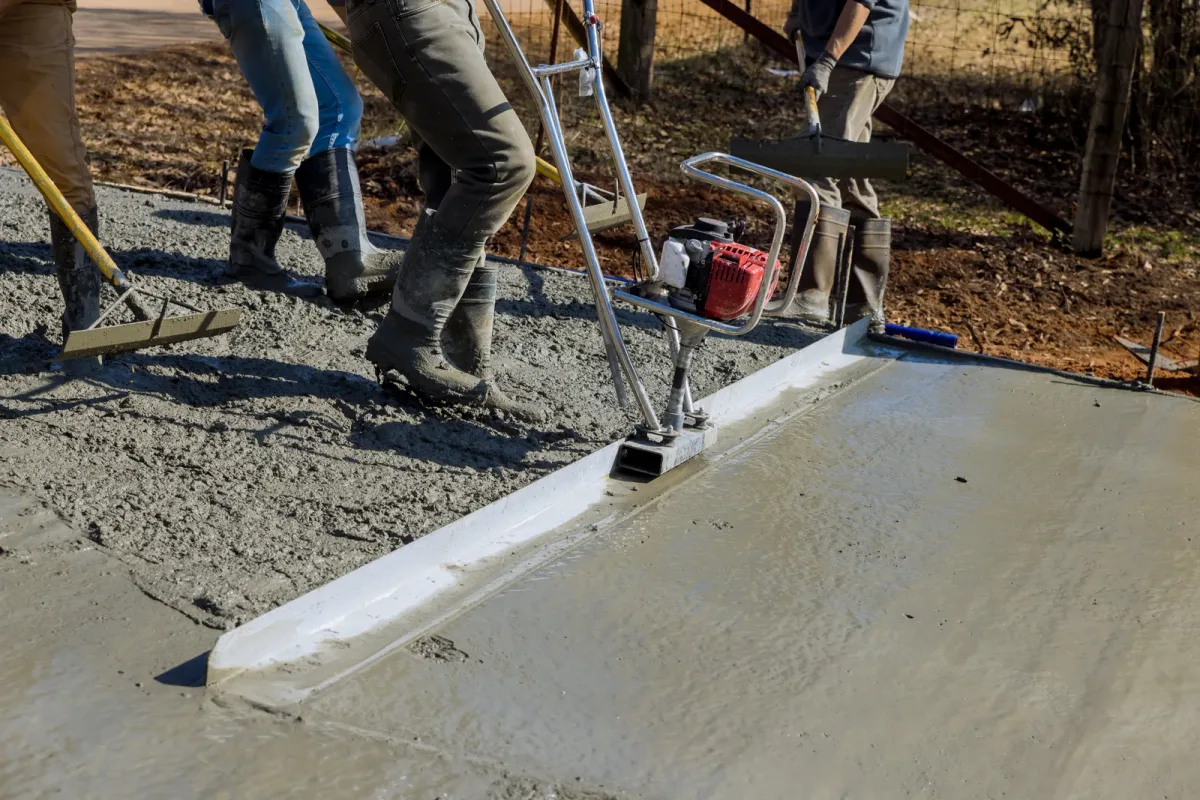
How to pick an agency that understands your pouring season, cure timelines, and the cost per booked pour that actually fills your calendar.
Why a generalist home services agency misses the pour
A lot of agencies lump concrete contractors in with the rest of the home services trades: build a site, run some local ads, chase reviews. That skips the one thing that actually runs a concrete business, the clock a ready-mix truck puts on every job. Once a load batches at the plant, the crew has to place, screed, and finish it before it starts to set, often inside two hours depending on the mix and the weather. Marketing that doesn't understand pour-day logistics ends up promising a homeowner a schedule the crew can't actually hit.
The second thing generalists get wrong is the comeback fear that's specific to poured concrete. Homeowners judge a bid on photos and a handshake, not the compaction under the forms, but what actually worries them is cracking, sinking, and, in freeze-thaw climates, scaling and spalling from deicing salt eating the surface a season or two after the pour. That's a different failure mode than a shifting paver or a rutting asphalt lot, and copy that doesn't answer it directly leaves the worry unaddressed.
Third, this trade runs on two very different buyer types with two different sales cycles: homeowners shopping driveways and patios off cost-per-square-foot searches, and builders or GCs bidding footings and slab-on-grade packages tied to a framing schedule. GC work is relationship-based and often locked in before a homeowner-facing campaign would ever touch it, so losing one builder account can empty a crew's calendar fast in a way no amount of homeowner traffic fixes. An agency that only knows how to run driveway ads is only fighting for half your revenue.
The first qualifying question: do they understand your pouring season?
Ask this before anything else: "How would you schedule my ad spend around my actual pouring season, not just around the calendar?" Concrete hydration needs a temperature window, most mixes want air and ground consistently above the low 40s degrees Fahrenheit to set correctly without cold-weather additives or blankets, so your season is bounded by climate, not by when leads happen to show up. An agency that runs a flat budget through a frozen month, or fails to ramp spend as your window opens, is wasting money on searches you can't book anyway.
The second half of the answer should cover cure timeline messaging, because it's one of the most common questions a homeowner asks before signing: walkable in roughly 24 to 48 hours, drivable around day 7, full design strength near 28 days. A firm that puts that timeline in plain language on the site, and texts it to every new customer, heads off a lot of "is it ready yet" calls and looks like the professional option next to a competitor who never mentions it.
A real specialist should also be able to talk about PSI, rebar versus welded wire mesh, and control joint layout in plain English without turning the page into a spec sheet, because that's exactly the trust signal that gets a homeowner comparing three bids to pick up the phone for yours instead of the cheapest one. If an agency can't speak to the season, the cure timeline, or the comeback fear unprompted, they're going to write generic "driveway contractor" copy that could belong to any trade.
Which channels actually fill the pour calendar
A concrete contractor's growth engine has to move with the season, not against it, and the channels work in a specific order.
A job-photo website comes first, because homeowners are judging your work on real driveways and patios you've poured, not a stock photo template. Plain-English pages on PSI, rebar, and joint layout, plus license and insurance shown up front, are what turn a browsing homeowner into a scheduled estimate.
Google Ads and local ads aimed at driveway, patio, and slab searches, and for the GC side of the business, footing and slab-on-grade searches, are the fastest way to book jobs once your window opens. The spend has to ramp up as the pouring season starts and ease off before the ground freezes, with every call and estimate request tracked back to the keyword that produced it, because a contractor who can't tell a proven ready-to-book search from a tire-kicker is going to overspend on the wrong month.
Local SEO and AI search carry the steadier volume for "concrete contractors near me" across every town you actually batch and pour in, and increasingly answer the question directly when a homeowner asks an AI assistant who should pour a driveway or fix a cracked slab. Reviews and follow-up close the loop: a review pipeline that turns a cured driveway into a steady stack of 5-star reviews answers the exact cracking and scaling worry the last contractor left behind, and automated follow-up that answers an estimate request the same day it comes in, plus a reminder when a sealed driveway is due for resealing, is what turns a one-time pour into next season's patio job.
The season is the business, and the number that actually matters
Almost no other home services trade is as climate-bounded as concrete. Your pouring window opens when the ground and air hold steady above freezing and closes when it doesn't, and hot, dry stretches bring the opposite problem, fast set time and shrinkage cracking without extra water control on the crew's end. A marketing plan that doesn't map spend to that window is either wasting budget in the off months or missing the ramp before your busiest weeks.
Because a single signed build, a driveway, a patio, a full slab-on-grade package, can carry a crew for weeks, lead quality matters far more than lead volume here. A real project with a real scope and a real budget behind it is worth more than ten tire-kicker calls, so the number to track isn't cost per lead, it's cost per booked pour, and separately, cost per repeat customer, because sealed concrete needs resealing on a multi-year cycle and a driveway customer today is next season's patio or garage-slab customer if you follow up.
Ask your agency directly: "How do you track cost per booked pour, not just cost per call, and how do you bring last year's driveway customers back for resealing or their next project?" An agency that only reports call volume is reporting the easy number instead of the one that actually fills your calendar.
Red flags, and the ownership questions that protect your business
A short list of signals tells you fast whether an agency will actually grow your concrete business, or just collect a check every month.
The biggest red flag is an agency that treats you like a generic local business instead of a weather-bounded trade. If they can't tell you how they'd adjust your spend for your actual climate and pouring season, they're going to run your budget the same way they'd run a plumber's, and you'll pay full price in months you can't even book a crew.
The second is a vendor who quietly holds all the keys. Find out up front whether your website, your domain, your Google Ads account, your Google Business Profile, and your customer data all sit in accounts with your name on them, not theirs. A company that builds your site somewhere you can't take it, or runs your ads from a login only they can see, is building a relationship that's painful to leave, not one built to make you successful.
Third, watch for guarantees of a specific ranking or job count. No honest agency promises that in a competitive local trade. And watch for reporting you can't verify against your own Google Ads account and your own call log. Ask directly whether you can log into every one of those accounts yourself right now, today. Hesitation on that question is the clearest answer you'll get.
Six questions to ask before you sign with any agency
Narrow your list to two or three, then run each candidate through the exact same six questions and see who answers with specifics instead of confidence.
One: "How would you ramp my ad spend around my actual pouring season and climate, not a generic calendar?" Two: "How do you put cure timelines and PSI, rebar, and joint layout in plain English so a homeowner trusts the bid before calling?" Three: "How do you track cost per booked pour, not just cost per lead or call?" Four: "How would you split my campaigns between homeowner driveway and patio searches and builder or GC footing and slab-on-grade work?" Five: "Do I own my website, my ad accounts, my Google Business Profile, and my customer data, and what happens to them if we part ways?" Six: "How do you bring back last season's driveway customers for resealing or their next project?"
The integration question matters more than it sounds. When your website, your ads, your local SEO, and your review requests are run by separate vendors, the seams are where jobs leak, the landing page doesn't match the ad, tracking breaks between tools, and nobody owns the whole path from search to signed estimate. SearchPod builds and runs a concrete contractor's website, ads, local SEO, and reviews as one connected team, publishes its prices openly, skips lock-in contracts, backs the work with a 30-day guarantee, and turns around a free proposal within one business day at /get-proposal. No honest agency will hand you a guaranteed ranking or job count in this trade, and we won't either. What a strong agency for concrete contractors can promise is that your season, your cure-timeline messaging, and your tracking are handled by people who've done it before, so your budget reaches booked pours instead of a slow month with nothing to show for it.