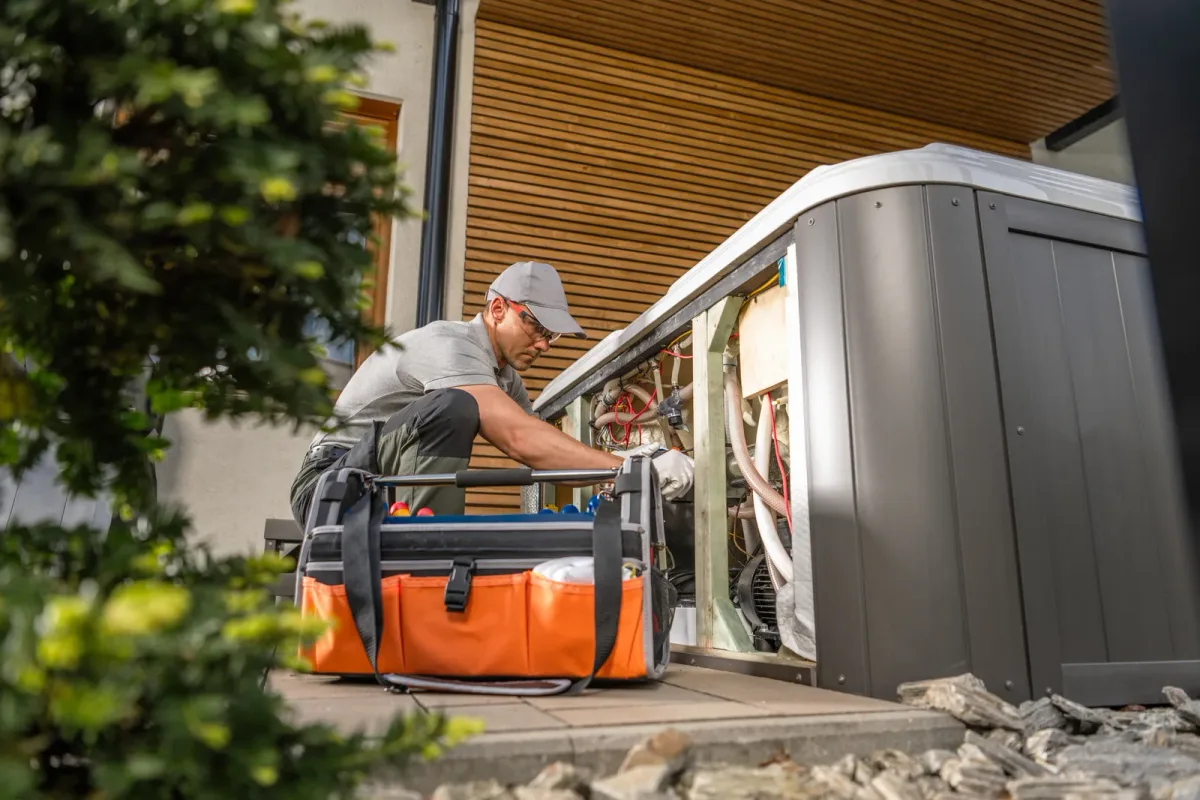
How a standby generator dealer wins both demand curves in 2026: new installs, storm driven repair calls, outranking the manufacturer locator, and maintenance renewals.
What marketing actually has to do for a generator dealer
This business runs on two completely different triggers, and a marketing system has to catch both. One is a homeowner deciding to buy a new standby system, usually after living through an outage or watching storm season approach, a consultative decision that takes weeks. The other is an existing owner whose unit just failed, often shown by a blinking amber light or an error code during a Generac's or Kohler's weekly self-exercise cycle, and that person wants a fix today, not a quote next week.
The decision maker in both cases is the homeowner. But the channel you're really competing against isn't only the dealer across town, it's the manufacturer's own “Find a Dealer” or “Find a Service Provider” locator, which a lot of homeowners go straight to instead of searching a business by name. Your own site, your local search ranking, and your AI-search visibility all have to outcompete that built-in placement, not just the other authorized dealers in your market.
A homeowner comparing dealers rarely understands the technical difference between certification tiers, but they do notice the badge itself, and a company that explains in plain language what an authorized designation actually means, factory training, parts access, warranty support, turns a piece of jargon into a real reason to choose one dealer over another.
The funnel, stage by stage
For a new install, it starts with a search or, just as often, the manufacturer's dealer locator, followed by a call or a quote request. The next step is consultative: a site visit, a load calculation, a decision on fuel source, and permitting, all before a multi-week install timeline even begins, which means the family is sitting on this decision for a while before they sign.
For a repair, the funnel compresses into hours, not weeks. “Generator won't start” spikes the moment an outage hits or a self-exercise cycle fails, and the homeowner who gets through to a real person first usually gets the job. The sale, in either case, is the signed install contract or the completed repair. What comes after decides whether that customer is worth more over time: an annual or bi-annual maintenance contract, oil, battery, and a load-bank test, is the steadiest revenue in this business, and it's also the easiest thing for a dealer to quietly under-sell once the install truck pulls away.
Permitting adds its own timeline pressure to the new-install side of the funnel, since most jurisdictions require an inspection before a standby system can be turned on, and a dealer who manages that step smoothly, rather than leaving the homeowner to coordinate with the local building department alone, turns a bureaucratic hassle into one more reason the family is glad they chose you.
The fuel-source decision itself, natural gas, propane, or diesel depending on what's available at the property, is one more variable a consultative sales process has to walk a family through clearly, since getting it wrong adds cost and delay partway through what's already a multi-week install.
The website that converts
A generator dealer's site is serving two visitors with very different needs at the same time: a homeowner pricing a brand-new system and one whose generator just failed. Authorized-dealer badges, Generac's PowerPro Premier, Elite, or Certified tiers, or an equivalent Kohler designation, matter here the way a license number matters to a contractor, because they're the fastest way to signal you're the real, factory-backed option and not a generalist electrician.
Clear pricing ranges and real installation photos help the new-buyer decision move along faster, since that's a family comparing options for weeks. For the visitor whose unit just died, the site needs a repair request that takes seconds, not a long form, because that person is standing in front of a dark house and won't wait around to fill one out.
Because a whole-home standby system is a significant purchase, mentioning financing options plainly on the page, rather than making a family ask about it during a sales call, removes a real hesitation point before it ever turns into a lead that quietly goes cold.
A short library of real customer photos from installs and repairs in your own area, not manufacturer stock images, helps a homeowner picture the actual crew that would show up at their own house, which matters a great deal in a purchase this significant.
Google Ads and local SEO for a generator dealer
Bid on both sides of the business at once: “generator installation near me” for new buyers, and “generator repair near me,” “generator won't start,” and the more specific “generac generator error light” for owners with a failed unit. Storm season compresses both search patterns into the same week or two, new quote requests and urgent repair calls spiking together, so ad budgets and staffing need to be ready to move together, then go quiet for months in between.
The local SEO fight here has an extra opponent most trades don't face: the manufacturer's own dealer locator, which often outranks an individual dealer's site by default. Winning your Google Business Profile category, keeping photos and reviews current, and building genuine local content around installs and repairs in your specific area is how a dealer earns a spot ahead of that built-in placement instead of relying on it to send business your way.
In regions where outages are common enough that homeowners already think about backup power before a storm even forms, it's worth running always-on visibility rather than waiting for a specific weather event to trigger a spending increase, since some of the best new-install leads come from a homeowner who simply got tired of worrying and decided to act.
Follow-up, email and text, and when to ask for a review
A new-install quote is a decision a family sits on for weeks, so follow-up that answers questions and keeps the timeline moving matters more here than in a same-day repair business. A repair estimate that waits on a callback goes cold just as fast, since an unanswered follow-up on either side hands the job to whoever calls next.
Storm-season reminders sent before the weather turns, checking whether a system is maintained and ready, do double duty: they protect the homeowner from a failure at the worst possible time, and they surface maintenance-contract renewals before they lapse. Ask for the review right after a successful install or repair, whether that's a brand-new system going in or a Sunday-morning fix that got the lights back on, since both are moments when a homeowner is genuinely relieved and willing to say so.
A reminder to register a new system's warranty shortly after install is a small, genuinely useful touchpoint that also gives you a clean, natural reason to check in and confirm everything's running the way it should.
What to measure, and what a good first 90 days looks like
Track cost per install lead and cost per repair call separately, since they're two different demand curves with different urgency and different margins, and a single blended number will hide which one is actually driving your growth. Maintenance-contract renewal rate deserves its own line too, because that recurring revenue is the easiest thing to lose sight of once the excitement of a new install fades.
A good first 90 days looks like a Google Business Profile and site that consistently outrank the manufacturer's own locator for your area, tracked ads running on both new-install and repair searches, and a maintenance-reminder system catching renewals before they quietly lapse. By the next storm season, you should be capturing the spike in both new quotes and urgent repair calls instead of watching homeowners land on someone else's site first. SearchPod pairs your website with tracked Google Ads and local SEO under a single team instead of separate vendors, at a rate of 10% on ad spend, $600 a month at the least, without any markup added in, and a free proposal arrives within one business day.
Maintenance-plan attach rate, the share of new installs that actually sign up for ongoing service, is worth watching closely at the point of sale, since a plan sold at install time is far easier to close than one pitched cold months later once the truck has already left.