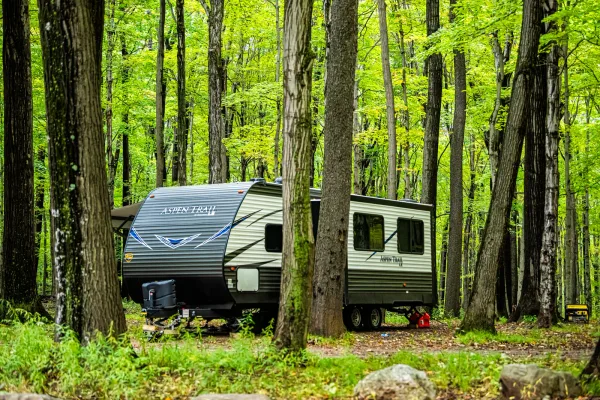
How an RV dealership markets a showroom and a service bay that run on different calendars: live inventory, brand and class pages, split ads, seasonal reminders, and cost per sold unit.
What marketing has to do for an RV dealership
An RV is the biggest purchase most families make outside a house and a car. New travel trailers and fifth wheels run into the tens of thousands, and diesel motorhomes go well into six figures. Buyers treat it like a mortgage. They cross-shop floor plans, tow ratings, and financing for weeks, they check what a unit is worth against published guides, and many will drive hours past the closest lot for the right unit at the right price. Marketing's first job is to be in that research, with proof, before the buyer picks a lot to visit.
The buying trigger is a life event or a season. A couple retires. A family decides on a summer of camping. Someone sells a house and wants to travel. Or an owner who has kept a unit for three to seven years decides to trade up from a towable to a motorized rig. The regional RV show circuit compresses those triggers into a few weekends a year, and camping season pulls the rest.
The decision maker is usually a couple, deciding together, with one of them doing most of the online research. The tow vehicle matters, so the truck in the driveway often decides which units are even possible.
The referral channel you compete with is the RV community. Camping clubs, Facebook owner groups, and campground neighbors tell each other where to buy and, more importantly, where the service department is honest. A dealer's reputation for pre-delivery inspection and warranty work travels through those groups faster than any ad. That is why the service bay is marketing, whether you treat it that way or not.
The funnel: showroom and service bay on different clocks
The sales funnel starts with a search: “rv dealers near me,” “travel trailers for sale near me,” “fifth wheels for sale [city],” a brand plus “dealer,” or a specific model name. Buyers also browse listing marketplaces like RV Trader and the manufacturers' own dealer locators. They land on your inventory, filter by class and floor plan, and check the price and the financing estimate. Then they call or send an inventory inquiry. From there the dealer's own next step is a showroom visit and a walkthrough of the unit, often with a financing pre-qualification done first. Then the sale, and then a pre-delivery inspection and a delivery walkthrough, where the dealer shows the buyer how the slides, the propane, the water system, and the awning work. That walkthrough is the start of the service relationship and the moment the review ask lands best.
The service funnel runs on a different calendar. Spring de-winterizing and fall winterizing are the two rushes, and they happen whether or not anyone is buying a unit that month. In between: roof membranes, slide-out seals, appliance repairs, warranty claims, and parts. Owners search “rv service near me,” “rv winterization near me,” and “rv repair [city],” and they also compare you against mobile RV techs who come to the campsite.
Tools: most dealers run a dealer management system built for RV lots, with inventory syndicated to the website and the marketplaces, and a CRM that logs internet leads. Service scheduling often lives in the same system. What matters for marketing is that every call and form carries its source, including the RV show it came from.
The website that turns research into a showroom visit
Inventory is the site. It must be live, synced from your DMS, sortable by class (travel trailer, fifth wheel, toy hauler, Class A, B, C), by floor plan features (bunkhouse, rear living, front kitchen), by brand, by length, and by sleeping capacity. Each unit page needs many photos, a floor plan image, a walkthrough video if you have one, the dry weight and hitch weight, the price, a payment estimate, and two buttons: “Schedule a walkthrough” and “Check availability.”
Pages you need beyond inventory: a page per brand you carry (Forest River, Keystone, Jayco, Winnebago, Grand Design, and the rest), written about that brand's lines and who they suit; a page per class; a financing page with a pre-qualification form that does not run a hard credit pull; a trade-in page with a value request form; a PDI and delivery page that explains your inspection process; a service department page with online booking for winterizing, de-winterizing, and repairs; a parts page; and a reviews page split into sales and service.
Proof that matters: the PDI process spelled out, your service department's reviews, years in business, the brands' dealer awards if you have them, and photos of real customers picking up real units. Buyers driving three hours want to know the unit will be ready and the paperwork will not be a surprise.
Forms should confirm by text and email within a minute and tell the buyer who will call. On a purchase this size, a same-day callback from a named salesperson is the difference between a visit and a ghost.
Google Ads and local SEO for RV shoppers and RV owners
Run sales and service as separate accounts or at least separate campaigns with separate budgets. Sales campaigns split by class: travel trailers, fifth wheels, toy haulers, motorhomes. Bid on “for sale near me” phrases, brand plus “dealer,” model names, and “rv dealership [city].” Bid on the towns two and three hours out, because buyers will travel. Leave out “rental,” “campground,” “rv park,” “parts diagram,” “manual,” and “for sale by owner.” Watch for “used” and decide whether you want it in the same campaign; used units convert differently.
Service campaigns bid on “rv winterization near me,” “rv de-winterizing,” “rv repair near me,” “rv roof repair,” “rv slide out repair,” and brand warranty terms. Raise service budgets in the six weeks before first frost and the six weeks before camping season opens. Cut sales budgets in the dead of winter unless you sell to snowbirds heading south.
Local SEO: your Google Business Profile should use the RV dealer category, with RV repair shop and RV supply store as secondary categories if you run both, list services with prices where you can, and post inventory arrivals and show dates. Photos should show the lot, the showroom, the service bays, and units on delivery day. Ask for sales reviews at delivery and service reviews at pickup, and reply to all of them.
Build a page per brand, a page per class, and a page per town in your drive radius. A page for a bunkhouse travel trailer buyer in the next county over should not read like the diesel pusher page.
One more thing: the same inventory feed goes to the marketplaces buyers browse before they ever visit your site. Keep the photos, prices, and stock status clean there, because that listing is often the first time a buyer sees the unit.
Follow-up for a slow decision, reminders for a fast season
Sales follow-up must match a decision that takes weeks. Within a minute of an inquiry: text and email confirmation. Within the hour: a call from a named salesperson. Same day: a short video of the exact unit, walked by that salesperson, sent by text. Two days later: a payment estimate and a note on what the trade-in might be worth. One week later: “still available, here's what changed on the lot.” Then every two weeks until they visit or say stop, with something useful each time: a floor plan comparison, a tow guide for their truck, a show reminder. After the visit: a thank-you the same day and a summary of the numbers.
After the sale: a delivery-day text, a two-week check-in, and a note at 30 days asking if anything needs a warranty look. Then the service calendar takes over: a winterizing reminder timed to your region's first frost, a de-winterizing reminder timed to the season opener, an annual roof and seal inspection reminder, and a parts or accessory note between visits. At the three-year mark, a trade-up note with what their unit is worth now.
Reviews: ask for the sales review at the delivery walkthrough, when the buyer is standing in their new unit. Ask for the service review at pickup, by text, with a direct link. Both moments are the peak of the customer's mood. A review that names the salesperson or the tech is the one other buyers trust.
What to measure and a good first 90 days
Measure cost per showroom visit, cost per sold unit, and cost per booked service job, and keep new units, used units, and service as three separate lines. Track inquiries by source, including RV shows, so you can compare a show weekend against a month of ads. Watch the inquiry-to-visit rate and the callback time, because on a purchase this size a slow callback is the leak. The monthly number to care about is sold units and booked service jobs by source, and what each cost.
A good first 90 days. Month one: the inventory site goes live with class and brand pages, the profile is completed, sales ads run on the fastest-moving classes, and service ads run if a rush is coming. Inquiries start in the first weeks and the callback process is in place before the ads. Month two: brand and town pages publish, the follow-up sequence runs behind the inquiries, and the first showroom visits from ad leads happen. Month three: the first units sell from those visits, service bookings from ads and reminders show up in the bay schedule, reviews start naming your people, and you can see cost per sold unit by class. If your quarter includes a rush or a show, the numbers will swing, so compare against the same weeks last year.
SearchPod manages Google Ads for 10% of your budget (minimum $600 a month, no markup on spend), builds SEO pages at $50 each from ten a month, and builds sites as one-time packages from $1,500 to $20,000+. There is no setup fee, it is month to month with a 30-day guarantee, and you get a free proposal within one business day.